<?xml version="1.0" encoding="UTF-8"?><rss version="2.0"
	xmlns:content="http://purl.org/rss/1.0/modules/content/"
	xmlns:wfw="http://wellformedweb.org/CommentAPI/"
	xmlns:dc="http://purl.org/dc/elements/1.1/"
	xmlns:atom="http://www.w3.org/2005/Atom"
	xmlns:sy="http://purl.org/rss/1.0/modules/syndication/"
	xmlns:slash="http://purl.org/rss/1.0/modules/slash/"
	>

<channel>
	<title>Customer Success | The ThriveMonger</title>
	<atom:link href="https://thrivemonger.com/tag/customer-success/feed/" rel="self" type="application/rss+xml" />
	<link>https://thrivemonger.com</link>
	<description>Business Coaching and Fractional Executive for Scale-Ups - ExO</description>
	<lastBuildDate>Wed, 18 Oct 2023 23:48:25 +0000</lastBuildDate>
	<language>en-US</language>
	<sy:updatePeriod>
	hourly	</sy:updatePeriod>
	<sy:updateFrequency>
	1	</sy:updateFrequency>
	<generator>https://wordpress.org/?v=7.0</generator>

<image>
	<url>https://thrivemonger.com/wp-content/uploads/2023/11/cropped-ThriveMonger-Icon-32x32.png</url>
	<title>Customer Success | The ThriveMonger</title>
	<link>https://thrivemonger.com</link>
	<width>32</width>
	<height>32</height>
</image> 
<site xmlns="com-wordpress:feed-additions:1">203600053</site>	<item>
		<title>Momentum, the Unstoppable Force (Repost) &#8211; The Daily PPILL #364</title>
		<link>https://thrivemonger.com/business-and-innovation-tdp/momentum-the-unstoppable-force-repost-the-daily-ppill-364/?utm_source=rss&#038;utm_medium=rss&#038;utm_campaign=momentum-the-unstoppable-force-repost-the-daily-ppill-364</link>
		
		<dc:creator><![CDATA[admin]]></dc:creator>
		<pubDate>Thu, 27 Jul 2023 12:50:00 +0000</pubDate>
				<category><![CDATA[Daily PPILL]]></category>
		<category><![CDATA[Leverage]]></category>
		<category><![CDATA[Customer Success]]></category>
		<category><![CDATA[EXO]]></category>
		<category><![CDATA[go to market strategy]]></category>
		<guid isPermaLink="false">https://channelmeister.com/?p=3954</guid>

					<description><![CDATA[<a href="https://thrivemonger.com/business-and-innovation-tdp/momentum-the-unstoppable-force-repost-the-daily-ppill-364/" title="Momentum, the Unstoppable Force (Repost) &#8211; The Daily PPILL #364" rel="nofollow"><img width="512" height="512" src="https://thrivemonger.com/wp-content/uploads/2023/06/flywheel.png" class="webfeedsFeaturedVisual wp-post-image" alt="" style="display: block; margin: auto; margin-bottom: 5px;max-width: 100%;" link_thumbnail="1" decoding="async" fetchpriority="high" srcset="https://thrivemonger.com/wp-content/uploads/2023/06/flywheel.png 512w, https://thrivemonger.com/wp-content/uploads/2023/06/flywheel-480x480.png 480w" sizes="(min-width: 0px) and (max-width: 480px) 480px, (min-width: 481px) 512px, 100vw" /></a><p>The captivating mechanics of flywheels, unlock the unstoppable force of momentum and they are the perfect analogy for exponential growth</p>
The post <a href="https://thrivemonger.com/business-and-innovation-tdp/momentum-the-unstoppable-force-repost-the-daily-ppill-364/">Momentum, the Unstoppable Force (Repost) – The Daily PPILL #364</a> appeared first on <a href="https://thrivemonger.com">The ThriveMonger</a>.]]></description>
										<content:encoded><![CDATA[<a href="https://thrivemonger.com/business-and-innovation-tdp/momentum-the-unstoppable-force-repost-the-daily-ppill-364/" title="Momentum, the Unstoppable Force (Repost) &#8211; The Daily PPILL #364" rel="nofollow"><img width="512" height="512" src="https://thrivemonger.com/wp-content/uploads/2023/06/flywheel.png" class="webfeedsFeaturedVisual wp-post-image" alt="" style="display: block; margin: auto; margin-bottom: 5px;max-width: 100%;" link_thumbnail="1" decoding="async" srcset="https://thrivemonger.com/wp-content/uploads/2023/06/flywheel.png 512w, https://thrivemonger.com/wp-content/uploads/2023/06/flywheel-480x480.png 480w" sizes="(min-width: 0px) and (max-width: 480px) 480px, (min-width: 481px) 512px, 100vw" /></a><p class="has-drop-cap wp-block-paragraph">In a world where technology is constantly advancing, simple yet ingenious inventions can capture our attention. The humble flywheel, often overlooked, these rotating wonders possess an appeal that inspires me, especially now that I am more and more involved with the creation of Exponential Organizations and the exponential technologies that are disrupting everything else!</p>


<p class="wp-block-paragraph">It runs out (I literally learned this TODAY!) the flywheel was the first ever wheel invented, and it stores rotational energy leveraging its mass. There are some modern applications, things like energy storage. Checkout <a href="https://airthium.com/" title="Airthium">Airthium</a>, which I am actually a modest investor in!</p>


<p class="wp-block-paragraph">Beyond their practical applications, what truly captivates me about flywheels is the way they work. The slow steady push that seems to do nothing at first, until it does, and then slowly builds, until is unstoppable!</p>


<p class="wp-block-paragraph">This is the behavior of Exponential Technologies, your Channel Program, and your Customer Success motion. Slowly building, going unnoticed, even disappointing at times, until it&#8217;s not. And until it&#8217;s unstoppable and everybody agrees that &#8220;it was genius&#8221;, &#8220;the only way to go&#8221;. </p>


<p class="wp-block-paragraph">Let&#8217;s build your Channel Go to Market Strategy. Let&#8217;s get your organization started on Customer Success Best Practices and apply the attributes of Exponential Organizations. Let&#8217;s stick to it. Let&#8217;s build momentum.</p>The post <a href="https://thrivemonger.com/business-and-innovation-tdp/momentum-the-unstoppable-force-repost-the-daily-ppill-364/">Momentum, the Unstoppable Force (Repost) – The Daily PPILL #364</a> appeared first on <a href="https://thrivemonger.com">The ThriveMonger</a>.]]></content:encoded>


		<post-id xmlns="com-wordpress:feed-additions:1">3954</post-id>	</item>
		<item>
		<title>The Unstoppable Force: Momentum &#8211; The Daily PPILL #329</title>
		<link>https://thrivemonger.com/business-and-innovation-tdp/the-unstoppable-force-momentum-the-daily-ppill-329/?utm_source=rss&#038;utm_medium=rss&#038;utm_campaign=the-unstoppable-force-momentum-the-daily-ppill-329</link>
		
		<dc:creator><![CDATA[admin]]></dc:creator>
		<pubDate>Thu, 08 Jun 2023 12:50:00 +0000</pubDate>
				<category><![CDATA[Daily PPILL]]></category>
		<category><![CDATA[Leverage]]></category>
		<category><![CDATA[Customer Success]]></category>
		<category><![CDATA[EXO]]></category>
		<category><![CDATA[go to market strategy]]></category>
		<guid isPermaLink="false">https://channelmeister.com/?p=3707</guid>

					<description><![CDATA[<a href="https://thrivemonger.com/business-and-innovation-tdp/the-unstoppable-force-momentum-the-daily-ppill-329/" title="The Unstoppable Force: Momentum &#8211; The Daily PPILL #329" rel="nofollow"><img width="512" height="512" src="https://thrivemonger.com/wp-content/uploads/2023/06/flywheel.png" class="webfeedsFeaturedVisual wp-post-image" alt="" style="display: block; margin: auto; margin-bottom: 5px;max-width: 100%;" link_thumbnail="1" decoding="async" srcset="https://thrivemonger.com/wp-content/uploads/2023/06/flywheel.png 512w, https://thrivemonger.com/wp-content/uploads/2023/06/flywheel-480x480.png 480w" sizes="(min-width: 0px) and (max-width: 480px) 480px, (min-width: 481px) 512px, 100vw" /></a><p>The captivating mechanics of flywheels, unlock the unstoppable force of momentum and they are the perfect analogy for exponential growth</p>
The post <a href="https://thrivemonger.com/business-and-innovation-tdp/the-unstoppable-force-momentum-the-daily-ppill-329/">The Unstoppable Force: Momentum – The Daily PPILL #329</a> appeared first on <a href="https://thrivemonger.com">The ThriveMonger</a>.]]></description>
										<content:encoded><![CDATA[<a href="https://thrivemonger.com/business-and-innovation-tdp/the-unstoppable-force-momentum-the-daily-ppill-329/" title="The Unstoppable Force: Momentum &#8211; The Daily PPILL #329" rel="nofollow"><img width="512" height="512" src="https://thrivemonger.com/wp-content/uploads/2023/06/flywheel.png" class="webfeedsFeaturedVisual wp-post-image" alt="" style="display: block; margin: auto; margin-bottom: 5px;max-width: 100%;" link_thumbnail="1" decoding="async" srcset="https://thrivemonger.com/wp-content/uploads/2023/06/flywheel.png 512w, https://thrivemonger.com/wp-content/uploads/2023/06/flywheel-480x480.png 480w" sizes="(min-width: 0px) and (max-width: 480px) 480px, (min-width: 481px) 512px, 100vw" /></a><p class="has-drop-cap wp-block-paragraph">In a world where technology is constantly advancing, simple yet ingenious inventions can capture our attention. The humble flywheel, often overlooked, these rotating wonders possess an appeal that inspires me, especially now that I am more and more involved with the creation of Exponential Organizations and the exponential technologies that are disrupting everything else!</p>


<p class="wp-block-paragraph">It runs out (I literally learned this TODAY!) the flywheel was the first ever wheel invented, and it stores rotational energy leveraging its mass. There are some modern applications, things like energy storage. Checkout <a href="https://airthium.com/" title="Airthium">Airthium</a>, which I am actually a modest investor in!</p>


<p class="wp-block-paragraph">Beyond their practical applications, what truly captivates me about flywheels is the way they work. The slow steady push that seems to do nothing at first, until it does, and then slowly builds, until is unstoppable!</p>


<p class="wp-block-paragraph">This is the behavior of Exponential Technologies, your Channel Program, and your Customer Success motion. Slowly building, going unnoticed, even disappointing at times, until it&#8217;s not. And until it&#8217;s unstoppable and everybody agrees that &#8220;it was genius&#8221;, &#8220;the only way to go&#8221;. </p>


<p class="wp-block-paragraph">Let&#8217;s build your Channel Go to Market Strategy. Let&#8217;s get your organization started on Customer Success Best Practices and apply the attributes of Exponential Organizations. Let&#8217;s stick to it. Let&#8217;s build momentum.</p>The post <a href="https://thrivemonger.com/business-and-innovation-tdp/the-unstoppable-force-momentum-the-daily-ppill-329/">The Unstoppable Force: Momentum – The Daily PPILL #329</a> appeared first on <a href="https://thrivemonger.com">The ThriveMonger</a>.]]></content:encoded>


		<post-id xmlns="com-wordpress:feed-additions:1">3707</post-id>	</item>
		<item>
		<title>Unlock growth in XaaS: Customer Success in the Customer Journey (Repost) &#8211; The Daily PPILL #279</title>
		<link>https://thrivemonger.com/business-and-innovation-tdp/why-customer-success-is-not-just-tech-support-repost-the-daily-ppill-279/?utm_source=rss&#038;utm_medium=rss&#038;utm_campaign=why-customer-success-is-not-just-tech-support-repost-the-daily-ppill-279</link>
		
		<dc:creator><![CDATA[admin]]></dc:creator>
		<pubDate>Thu, 30 Mar 2023 12:50:00 +0000</pubDate>
				<category><![CDATA[Daily PPILL]]></category>
		<category><![CDATA[Leverage]]></category>
		<category><![CDATA[Customer Success]]></category>
		<category><![CDATA[LAER]]></category>
		<category><![CDATA[Renewal Rate]]></category>
		<category><![CDATA[technology adoption]]></category>
		<guid isPermaLink="false">https://channelmeister.com/?p=3435</guid>

					<description><![CDATA[<a href="https://thrivemonger.com/business-and-innovation-tdp/why-customer-success-is-not-just-tech-support-repost-the-daily-ppill-279/" title="Unlock growth in XaaS: Customer Success in the Customer Journey (Repost) &#8211; The Daily PPILL #279" rel="nofollow"><img width="1536" height="1025" src="https://thrivemonger.com/wp-content/uploads/2022/02/pexels-photo-3183202-1536x1025.jpeg" class="webfeedsFeaturedVisual wp-post-image" alt="person using macbook pro" style="display: block; margin: auto; margin-bottom: 5px;max-width: 100%;" link_thumbnail="1" decoding="async" srcset="https://thrivemonger.com/wp-content/uploads/2022/02/pexels-photo-3183202-1536x1025.jpeg 1536w, https://thrivemonger.com/wp-content/uploads/2022/02/pexels-photo-3183202-1280x854.jpeg 1280w, https://thrivemonger.com/wp-content/uploads/2022/02/pexels-photo-3183202-980x654.jpeg 980w, https://thrivemonger.com/wp-content/uploads/2022/02/pexels-photo-3183202-480x320.jpeg 480w" sizes="(min-width: 0px) and (max-width: 480px) 480px, (min-width: 481px) and (max-width: 980px) 980px, (min-width: 981px) and (max-width: 1280px) 1280px, (min-width: 1281px) 1536px, 100vw" /></a><p>Gone are the days when Solutions Providers would install a system, make a few tests and walk away. Adoption of new solutions is crucial for unlocking the profits of the long tail in XaaS offerings.</p>
The post <a href="https://thrivemonger.com/business-and-innovation-tdp/why-customer-success-is-not-just-tech-support-repost-the-daily-ppill-279/">Unlock growth in XaaS: Customer Success in the Customer Journey (Repost) – The Daily PPILL #279</a> appeared first on <a href="https://thrivemonger.com">The ThriveMonger</a>.]]></description>
										<content:encoded><![CDATA[<a href="https://thrivemonger.com/business-and-innovation-tdp/why-customer-success-is-not-just-tech-support-repost-the-daily-ppill-279/" title="Unlock growth in XaaS: Customer Success in the Customer Journey (Repost) &#8211; The Daily PPILL #279" rel="nofollow"><img width="1536" height="1025" src="https://thrivemonger.com/wp-content/uploads/2022/02/pexels-photo-3183202-1536x1025.jpeg" class="webfeedsFeaturedVisual wp-post-image" alt="person using macbook pro" style="display: block; margin: auto; margin-bottom: 5px;max-width: 100%;" link_thumbnail="1" decoding="async" loading="lazy" srcset="https://thrivemonger.com/wp-content/uploads/2022/02/pexels-photo-3183202-1536x1025.jpeg 1536w, https://thrivemonger.com/wp-content/uploads/2022/02/pexels-photo-3183202-1280x854.jpeg 1280w, https://thrivemonger.com/wp-content/uploads/2022/02/pexels-photo-3183202-980x654.jpeg 980w, https://thrivemonger.com/wp-content/uploads/2022/02/pexels-photo-3183202-480x320.jpeg 480w" sizes="(min-width: 0px) and (max-width: 480px) 480px, (min-width: 481px) and (max-width: 980px) 980px, (min-width: 981px) and (max-width: 1280px) 1280px, (min-width: 1281px) 1536px, 100vw" /></a><p class="has-drop-cap wp-block-paragraph">In a world where products are increasingly being replaced by services, it is important to understand the role that customer service plays and how it can affect the rate of user attrition. In the XaaS universe, where everything is offered on a monthly payment basis, the only metric that really matters to measure the performance of a company is the net growth rate of an account, or the aggregate of all accounts. Other metrics, such as sales volume, take a backseat.</p>


<p class="wp-block-paragraph">Paraphrasing the obvious, if a company that has a subscription product is acquiring new clients (selling), but in turn, losing clients (attrition) with a greater speed, their overall revenue and client base will be contracting. Traditional sales models generally ignore this dynamic.</p>


<script>
    var ml_webform_5838252 = ml_account('webforms', '5838252', 'z2j2d5', 'load');
    ml_webform_5838252('animation', 'fadeIn');
</script>


<p class="wp-block-paragraph">There is a lot of good content out there about Customer Success, Change Management or even the LAER cycle (this last one making waves all across the industry), but the reason I decided to write this article is that I couldn&#8217;t find one single piece of content that would cover how these three things deeply interrelate.</p>


<p class="wp-block-paragraph"><strong>THE CUSTOMER JOURNEY IN TRADITIONAL PRODUCT SALES</strong></p>


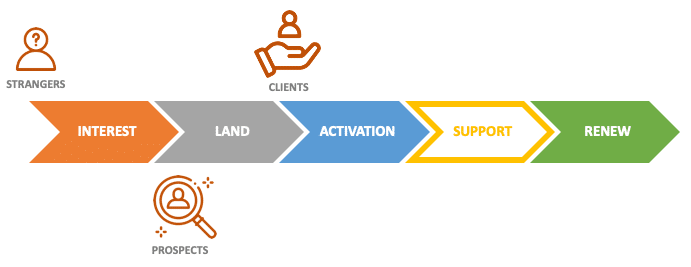
<p class="wp-block-paragraph">The traditional model of the customer journey is usually represented in a linear fashion. Customers encounter the company&#8217;s solutions, becoming aware of them through the company&#8217;s marketing efforts. Immediately, the sales team approaches the client to verify interest, and if the solution fits within the client&#8217;s needs, and the client has an urgency to buy, the transaction is closed and the installation and activation phase are initiated.</p>


<p class="wp-block-paragraph">This is how customers go from being strangers to prospects, finally becoming real customers of the company.</p>


<figure class="wp-block-image aligncenter size-full"><img loading="lazy" decoding="async" width="691" height="267" src="https://channelmeister.com/wp-content/uploads/2022/03/LAER-Enablement-Presentation4.png" alt="" class="wp-image-1525" srcset="https://channelmeister.com/wp-content/uploads/2022/03/LAER-Enablement-Presentation4.png 691w, https://channelmeister.com/wp-content/uploads/2022/03/LAER-Enablement-Presentation4-480x185.png 480w" sizes="(min-width: 0px) and (max-width: 480px) 480px, (min-width: 481px) 691px, 100vw" /><figcaption class="wp-element-caption">Traditional Customer Journey model</figcaption></figure>


<p class="wp-block-paragraph">Under this traditional model, once the transaction is done and the product is delivered and installed, the company typically has little interaction with the customer and only becomes involved again if a problem arises, or once the customer decides to refresh their solution.</p>


<p class="wp-block-paragraph"><strong>THE CUSTOMER JOURNEY IN THE XaaS WORLD</strong></p>


<p class="wp-block-paragraph">There are two very important differences with the previous model in the world of services, or &#8220;as a service&#8221;.</p>


<p class="wp-block-paragraph">The first is that the customer has the option to cancel the service at any time. It is true, that on many occasions there are early cancellation clauses, but the option still exists. Once the captive period ends, the client can forego continuing with the services. Most often than not, this happens because the client is not fully using the solution and, as we say, is not &#8220;extracting the full value&#8221; of the solution. In the vast majority of cases, this is due to poor adoption of the solution within the client&#8217;s organization. The solution was purchased and installed, but nobody uses it anymore. It makes total sense that the client would end up canceling the service if they are not utilizing it.</p>


<p class="wp-block-paragraph">The second difference is that when the customer goes through a stellar cycle of adoption, they usually discover new uses for the solution, and many times, add more users to it.</p>


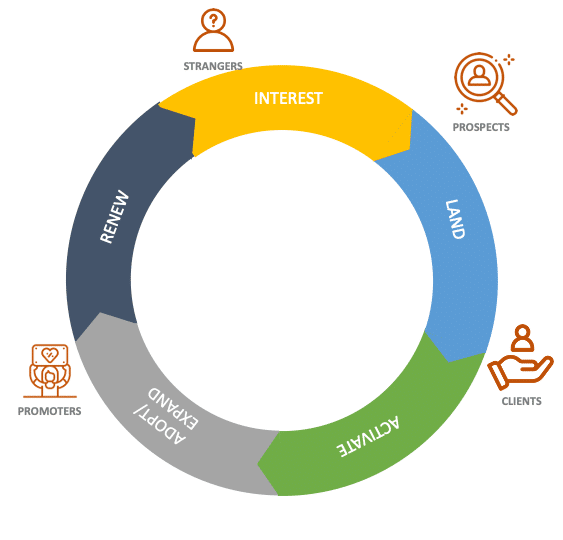
<p class="wp-block-paragraph">These particularities are what gave rise to a new paradigm of the customer journey, and in particular, I am referring to the LAER model. The acronym stands for LAND, ADOPT, EXPAND, and RENEW. For the sake of completeness and to be able to compare it with the previous graphic, I added here the initial encounter with the product, and the installation or activation phases as well. </p>


<p class="wp-block-paragraph"></p>


<figure class="wp-block-image aligncenter size-full"><img loading="lazy" decoding="async" width="563" height="540" src="https://channelmeister.com/wp-content/uploads/2022/04/LAER-Enablement-Presentation3.png" alt="" class="wp-image-1526" srcset="https://channelmeister.com/wp-content/uploads/2022/04/LAER-Enablement-Presentation3.png 563w, https://channelmeister.com/wp-content/uploads/2022/04/LAER-Enablement-Presentation3-480x460.png 480w" sizes="(min-width: 0px) and (max-width: 480px) 480px, (min-width: 481px) 563px, 100vw" /><figcaption class="wp-element-caption">Expanded LAER model </figcaption></figure>


<p class="wp-block-paragraph">We just briefly discussed Adoption and Expansion. Land refers to the initial sale, when we &#8220;land&#8221; at an account. Obviously, the Renewal is when the commitment to continue in the commercial relationship is reestablished. It is important to note, that these loops can be made as fast and granular as desired. In fact, technically in many XaaS solutions, the renewal cycle occurs in periods of one month, or even continually, when the customer is at &#8220;one click to cancel&#8221;.</p>


<p class="wp-block-paragraph">The importance of adopting this model lies in the fact that ALL stages can positively or negatively affect the company&#8217;s turnover. Just as an example, it is possible to increase revenue by Landing more customers, making a new customer better Adopt the solution, or an existing one Expand the use of the solution and Renew. </p>


<p class="wp-block-paragraph">I find this model useful not only in the context of technology services, but also in any scenario where there is a service that is contracted in a recurring model. Of course, in these I include services such as Spotify or Netflix, where an example of proper adoption could be having properly configured the &#8220;playlists&#8221;, so that you can listen to or watch the content that you really like; But the model extends to other areas as well: paying rent, health insurance, gym memberships, condo payments, and even paying property taxes.</p>


<p class="wp-block-paragraph"><strong>THE TRUE ROLE OF CUSTOMER SUCCESS MANAGEMENT</strong></p>


<p class="wp-block-paragraph">One of the main reasons that motivated me to write this article is to have seen how the terms &#8220;Customer Success&#8221;, &#8220;Customer Service&#8221;, and even &#8220;Support&#8221; are used interchangeably, and unfortunately incorrectly; many times by the same people responsible for implementing these processes.</p>


<p class="wp-block-paragraph">A good approximation to the definition of Customer Success is that it is a methodology that aims for customers to achieve the desired results while using our solution. </p>


<p class="wp-block-paragraph">Ultimately, the goal is for the customer to receive the maximum value from the solution and thereby adopt it, expand its use, and renew it.</p>


<p class="wp-block-paragraph">And this is where the fundamental difference between a support discipline and Customer Success is defined. In a traditional form of Customer Satisfaction or Technical Support, the goal is to make sure that the solution is working as promised. In this sense, it was often acceptable for the Technical Service department to pronounce -words more, words less- an odious: &#8220;the solution is designed to work like this, it is you, Mrs. (or Mr.) customer who is using it wrong&#8221;. This is where the phrase &#8220;Layer 8 issue&#8221; was born, cynically referring to the user, who is above layer 7 (application) of the OSI model.<br>In contrast, when we shift to Customer Success (and I hope it will become clear how important it is, now than ever), we must not only make sure that the solution is working as promised, but emphasis must shift to make sure that the user is utilizing it appropriately, and even more, using it to its full potential. In this sense and under the LAER model, it becomes very important that the client not only buys the solution but also implements it as it should, uses it confidently, seeks to use all its functionalities, and finally recommends it to be used in other areas of the company and by more end users.</p>


<figure class="wp-block-pullquote"><blockquote><p>For the traditional model of Customer Satisfaction or Technical Support, the goal is to make sure that the solution is working as promised. When we shift to Customer Success in the XaaS world, the emphasis should be that the user leverages its full potential</p></blockquote></figure>


<p class="wp-block-paragraph">In the world of everything-as-a-service, it is of course extremely important to implement initiatives generally associated with Landing -among them adjusting sales compensation plans to make it more attractive and making sales partially responsible for retaining customers; increasing the speed of the flywheel of the marketing and sales process to accommodate smaller transactions; and automate the provisioning and billing processes to be able to do it repeatedly and fluidly- but the role of Support and Customer Success Management is essential to face the challenge and unlock the profits of the long tail of the model -the AER piece- in the adoption, expansion, and renewal; requiring to redefine the goals and metrics pursued by each of these departments. </p>


<figure class="wp-block-pullquote"><blockquote><p><em>as-a-service further aligns the customer and the vendor&#8217;s goals &#8211; true &#8220;Customer Success&#8221; is the only way for the vendor&#8217;s own success</em></p></blockquote></figure>


<p class="wp-block-paragraph">As-a-service models have lovers and haters. As humans, we still like the idea of owning something. It gives us the feeling that come hell or high water, we could still count on what we have, ignoring the fact that technology solutions eventually become obsolete as they get caught in the relentless cycle of innovation. On the flip side, as-a-service focuses on the benefits, and it further aligns the customer and the vendor&#8217;s goals, so true &#8220;Customer Success&#8221; is the only way for the vendor&#8217;s own success.</p>


<p class="wp-block-paragraph">For more on how XaaS businesses can build a solid foundation based on Customer Success practices, <a href="javascript:;" onclick="ml_webform_5838252('show')">download our free booklet &#8220;Customer Success: The imperative for XaaS businesses&#8221;</a>. </p>The post <a href="https://thrivemonger.com/business-and-innovation-tdp/why-customer-success-is-not-just-tech-support-repost-the-daily-ppill-279/">Unlock growth in XaaS: Customer Success in the Customer Journey (Repost) – The Daily PPILL #279</a> appeared first on <a href="https://thrivemonger.com">The ThriveMonger</a>.]]></content:encoded>


		<post-id xmlns="com-wordpress:feed-additions:1">3435</post-id>	</item>
		<item>
		<title>Customer Success and the Layer 8 error (Repeat) &#8211; The Daily PPILL #264</title>
		<link>https://thrivemonger.com/business-and-innovation-tdp/customer-success-and-the-layer-8-error-repeat-the-daily-ppill-264/?utm_source=rss&#038;utm_medium=rss&#038;utm_campaign=customer-success-and-the-layer-8-error-repeat-the-daily-ppill-264</link>
		
		<dc:creator><![CDATA[admin]]></dc:creator>
		<pubDate>Thu, 09 Mar 2023 13:50:00 +0000</pubDate>
				<category><![CDATA[Daily PPILL]]></category>
		<category><![CDATA[Leverage]]></category>
		<category><![CDATA[Customer Success]]></category>
		<category><![CDATA[LAER]]></category>
		<category><![CDATA[Renewal Rate]]></category>
		<category><![CDATA[technology adoption]]></category>
		<guid isPermaLink="false">https://channelmeister.com/?p=3342</guid>

					<description><![CDATA[<a href="https://thrivemonger.com/business-and-innovation-tdp/customer-success-and-the-layer-8-error-repeat-the-daily-ppill-264/" title="Customer Success and the Layer 8 error (Repeat) &#8211; The Daily PPILL #264" rel="nofollow"><img width="1536" height="1025" src="https://thrivemonger.com/wp-content/uploads/2022/02/pexels-photo-3183202-1536x1025.jpeg" class="webfeedsFeaturedVisual wp-post-image" alt="person using macbook pro" style="display: block; margin: auto; margin-bottom: 5px;max-width: 100%;" link_thumbnail="1" decoding="async" loading="lazy" srcset="https://thrivemonger.com/wp-content/uploads/2022/02/pexels-photo-3183202-1536x1025.jpeg 1536w, https://thrivemonger.com/wp-content/uploads/2022/02/pexels-photo-3183202-1280x854.jpeg 1280w, https://thrivemonger.com/wp-content/uploads/2022/02/pexels-photo-3183202-980x654.jpeg 980w, https://thrivemonger.com/wp-content/uploads/2022/02/pexels-photo-3183202-480x320.jpeg 480w" sizes="(min-width: 0px) and (max-width: 480px) 480px, (min-width: 481px) and (max-width: 980px) 980px, (min-width: 981px) and (max-width: 1280px) 1280px, (min-width: 1281px) 1536px, 100vw" /></a><p>Gone are the days when Solutions Providers would install a system, make a few tests and walk away. Adoption of new solutions is crucial for unlocking the profits of the long tail in XaaS offerings.</p>
The post <a href="https://thrivemonger.com/business-and-innovation-tdp/customer-success-and-the-layer-8-error-repeat-the-daily-ppill-264/">Customer Success and the Layer 8 error (Repeat) – The Daily PPILL #264</a> appeared first on <a href="https://thrivemonger.com">The ThriveMonger</a>.]]></description>
										<content:encoded><![CDATA[<a href="https://thrivemonger.com/business-and-innovation-tdp/customer-success-and-the-layer-8-error-repeat-the-daily-ppill-264/" title="Customer Success and the Layer 8 error (Repeat) &#8211; The Daily PPILL #264" rel="nofollow"><img width="1536" height="1025" src="https://thrivemonger.com/wp-content/uploads/2022/02/pexels-photo-3183202-1536x1025.jpeg" class="webfeedsFeaturedVisual wp-post-image" alt="person using macbook pro" style="display: block; margin: auto; margin-bottom: 5px;max-width: 100%;" link_thumbnail="1" decoding="async" loading="lazy" srcset="https://thrivemonger.com/wp-content/uploads/2022/02/pexels-photo-3183202-1536x1025.jpeg 1536w, https://thrivemonger.com/wp-content/uploads/2022/02/pexels-photo-3183202-1280x854.jpeg 1280w, https://thrivemonger.com/wp-content/uploads/2022/02/pexels-photo-3183202-980x654.jpeg 980w, https://thrivemonger.com/wp-content/uploads/2022/02/pexels-photo-3183202-480x320.jpeg 480w" sizes="(min-width: 0px) and (max-width: 480px) 480px, (min-width: 481px) and (max-width: 980px) 980px, (min-width: 981px) and (max-width: 1280px) 1280px, (min-width: 1281px) 1536px, 100vw" /></a><p class="has-drop-cap wp-block-paragraph">In a world where products are increasingly being replaced by services, it is important to understand the role that customer service plays and how it can affect the rate of user attrition. In the XaaS universe, where everything is offered on a monthly payment basis, the only metric that really matters to measure the performance of a company is the net growth rate of an account, or the aggregate of all accounts. Other metrics, such as sales volume, take a backseat.</p>


<p class="wp-block-paragraph">Paraphrasing the obvious, if a company that has a subscription product is acquiring new clients (selling), but in turn, losing clients (attrition) with a greater speed, their overall revenue and client base will be contracting. Traditional sales models generally ignore this dynamic.</p>


<script>
    var ml_webform_5838252 = ml_account('webforms', '5838252', 'z2j2d5', 'load');
    ml_webform_5838252('animation', 'fadeIn');
</script>


<p class="wp-block-paragraph">There is a lot of good content out there about Customer Success, Change Management or even the LAER cycle (this last one making waves all across the industry), but the reason I decided to write this article is that I couldn&#8217;t find one single piece of content that would cover how these three things deeply interrelate.</p>


<p class="wp-block-paragraph"><strong>THE CUSTOMER JOURNEY IN TRADITIONAL PRODUCT SALES</strong></p>


<p class="wp-block-paragraph">The traditional model of the customer journey is usually represented in a linear fashion. Customers encounter the company&#8217;s solutions, becoming aware of them through the company&#8217;s marketing efforts. Immediately, the sales team approaches the client to verify interest, and if the solution fits within the client&#8217;s needs, and the client has an urgency to buy, the transaction is closed and the installation and activation phase are initiated.</p>


<p class="wp-block-paragraph">This is how customers go from being strangers to prospects, finally becoming real customers of the company.</p>


<figure class="wp-block-image aligncenter size-full"><img loading="lazy" decoding="async" width="691" height="267" src="https://channelmeister.com/wp-content/uploads/2022/03/LAER-Enablement-Presentation4.png" alt="" class="wp-image-1525" srcset="https://channelmeister.com/wp-content/uploads/2022/03/LAER-Enablement-Presentation4.png 691w, https://channelmeister.com/wp-content/uploads/2022/03/LAER-Enablement-Presentation4-480x185.png 480w" sizes="(min-width: 0px) and (max-width: 480px) 480px, (min-width: 481px) 691px, 100vw" /><figcaption class="wp-element-caption">Traditional Customer Journey model</figcaption></figure>


<p class="wp-block-paragraph">Under this traditional model, once the transaction is done and the product is delivered and installed, the company typically has little interaction with the customer and only becomes involved again if a problem arises, or once the customer decides to refresh their solution.</p>


<p class="wp-block-paragraph"><strong>THE CUSTOMER JOURNEY IN THE XaaS WORLD</strong></p>


<p class="wp-block-paragraph">There are two very important differences with the previous model in the world of services, or &#8220;as a service&#8221;.</p>


<p class="wp-block-paragraph">The first is that the customer has the option to cancel the service at any time. It is true, that on many occasions there are early cancellation clauses, but the option still exists. Once the captive period ends, the client can forego continuing with the services. Most often than not, this happens because the client is not fully using the solution and, as we say, is not &#8220;extracting the full value&#8221; of the solution. In the vast majority of cases, this is due to poor adoption of the solution within the client&#8217;s organization. The solution was purchased and installed, but nobody uses it anymore. It makes total sense that the client would end up canceling the service if they are not utilizing it.</p>


<p class="wp-block-paragraph">The second difference is that when the customer goes through a stellar cycle of adoption, they usually discover new uses for the solution, and many times, add more users to it.</p>


<p class="wp-block-paragraph">These particularities are what gave rise to a new paradigm of the customer journey, and in particular, I am referring to the LAER model. The acronym stands for LAND, ADOPT, EXPAND, and RENEW. For the sake of completeness and to be able to compare it with the previous graphic, I added here the initial encounter with the product, and the installation or activation phases as well. </p>


<p class="wp-block-paragraph"></p>


<figure class="wp-block-image aligncenter size-full"><img loading="lazy" decoding="async" width="563" height="540" src="https://channelmeister.com/wp-content/uploads/2022/04/LAER-Enablement-Presentation3.png" alt="" class="wp-image-1526" srcset="https://channelmeister.com/wp-content/uploads/2022/04/LAER-Enablement-Presentation3.png 563w, https://channelmeister.com/wp-content/uploads/2022/04/LAER-Enablement-Presentation3-480x460.png 480w" sizes="(min-width: 0px) and (max-width: 480px) 480px, (min-width: 481px) 563px, 100vw" /><figcaption class="wp-element-caption">Expanded LAER model </figcaption></figure>


<p class="wp-block-paragraph">We just briefly discussed Adoption and Expansion. Land refers to the initial sale, when we &#8220;land&#8221; at an account. Obviously, the Renewal is when the commitment to continue in the commercial relationship is reestablished. It is important to note, that these loops can be made as fast and granular as desired. In fact, technically in many XaaS solutions, the renewal cycle occurs in periods of one month, or even continually, when the customer is at &#8220;one click to cancel&#8221;.</p>


<p class="wp-block-paragraph">The importance of adopting this model lies in the fact that ALL stages can positively or negatively affect the company&#8217;s turnover. Just as an example, it is possible to increase revenue by Landing more customers, making a new customer better Adopt the solution, or an existing one Expand the use of the solution and Renew. </p>


<p class="wp-block-paragraph">I find this model useful not only in the context of technology services, but also in any scenario where there is a service that is contracted in a recurring model. Of course, in these I include services such as Spotify or Netflix, where an example of proper adoption could be having properly configured the &#8220;playlists&#8221;, so that you can listen to or watch the content that you really like; But the model extends to other areas as well: paying rent, health insurance, gym memberships, condo payments, and even paying property taxes.</p>


<p class="wp-block-paragraph"><strong>THE TRUE ROLE OF CUSTOMER SUCCESS MANAGEMENT</strong></p>


<p class="wp-block-paragraph">One of the main reasons that motivated me to write this article is to have seen how the terms &#8220;Customer Success&#8221;, &#8220;Customer Service&#8221;, and even &#8220;Support&#8221; are used interchangeably, and unfortunately incorrectly; many times by the same people responsible for implementing these processes.</p>


<p class="wp-block-paragraph">A good approximation to the definition of Customer Success is that it is a methodology that aims for customers to achieve the desired results while using our solution. </p>


<p class="wp-block-paragraph">Ultimately, the goal is for the customer to receive the maximum value from the solution and thereby adopt it, expand its use, and renew it.</p>


<p class="wp-block-paragraph">And this is where the fundamental difference between a support discipline and Customer Success is defined. In a traditional form of Customer Satisfaction or Technical Support, the goal is to make sure that the solution is working as promised. In this sense, it was often acceptable for the Technical Service department to pronounce -words more, words less- an odious: &#8220;the solution is designed to work like this, it is you, Mrs. (or Mr.) customer who is using it wrong&#8221;. This is where the phrase &#8220;Layer 8 issue&#8221; was born, cynically referring to the user, who is above layer 7 (application) of the OSI model.<br>In contrast, when we shift to Customer Success (and I hope it will become clear how important it is, now than ever), we must not only make sure that the solution is working as promised, but emphasis must shift to make sure that the user is utilizing it appropriately, and even more, using it to its full potential. In this sense and under the LAER model, it becomes very important that the client not only buys the solution but also implements it as it should, uses it confidently, seeks to use all its functionalities, and finally recommends it to be used in other areas of the company and by more end users.</p>


<figure class="wp-block-pullquote"><blockquote><p>For the traditional model of Customer Satisfaction or Technical Support, the goal is to make sure that the solution is working as promised. When we shift to Customer Success in the XaaS world, the emphasis should be that the user leverages its full potential</p></blockquote></figure>


<p class="wp-block-paragraph">In the world of everything-as-a-service, it is of course extremely important to implement initiatives generally associated with Landing -among them adjusting sales compensation plans to make it more attractive and making sales partially responsible for retaining customers; increasing the speed of the flywheel of the marketing and sales process to accommodate smaller transactions; and automate the provisioning and billing processes to be able to do it repeatedly and fluidly- but the role of Support and Customer Success Management is essential to face the challenge and unlock the profits of the long tail of the model -the AER piece- in the adoption, expansion, and renewal; requiring to redefine the goals and metrics pursued by each of these departments. </p>


<figure class="wp-block-pullquote"><blockquote><p><em>as-a-service further aligns the customer and the vendor&#8217;s goals &#8211; true &#8220;Customer Success&#8221; is the only way for the vendor&#8217;s own success</em></p></blockquote></figure>


<p class="wp-block-paragraph">As-a-service models have lovers and haters. As humans, we still like the idea of owning something. It gives us the feeling that come hell or high water, we could still count on what we have, ignoring the fact that technology solutions eventually become obsolete as they get caught in the relentless cycle of innovation. On the flip side, as-a-service focuses on the benefits, and it further aligns the customer and the vendor&#8217;s goals, so true &#8220;Customer Success&#8221; is the only way for the vendor&#8217;s own success.</p>


<p class="wp-block-paragraph">For more on how XaaS businesses can build a solid foundation based on Customer Success practices, <a href="javascript:;" onclick="ml_webform_5838252('show')">download our free booklet &#8220;Customer Success: The imperative for XaaS businesses&#8221;</a>. </p>The post <a href="https://thrivemonger.com/business-and-innovation-tdp/customer-success-and-the-layer-8-error-repeat-the-daily-ppill-264/">Customer Success and the Layer 8 error (Repeat) – The Daily PPILL #264</a> appeared first on <a href="https://thrivemonger.com">The ThriveMonger</a>.]]></content:encoded>


		<post-id xmlns="com-wordpress:feed-additions:1">3342</post-id>	</item>
		<item>
		<title>Customer Success and the Layer 8 error (Repeat) &#8211; The Daily PPILL #234</title>
		<link>https://thrivemonger.com/business-and-innovation-tdp/customer-success-and-the-layer-8-error-the-daily-ppill-234/?utm_source=rss&#038;utm_medium=rss&#038;utm_campaign=customer-success-and-the-layer-8-error-the-daily-ppill-234</link>
		
		<dc:creator><![CDATA[admin]]></dc:creator>
		<pubDate>Thu, 26 Jan 2023 13:50:00 +0000</pubDate>
				<category><![CDATA[Daily PPILL]]></category>
		<category><![CDATA[Leverage]]></category>
		<category><![CDATA[Customer Success]]></category>
		<category><![CDATA[LAER]]></category>
		<category><![CDATA[Renewal Rate]]></category>
		<category><![CDATA[technology adoption]]></category>
		<guid isPermaLink="false">https://channelmeister.com/?p=3019</guid>

					<description><![CDATA[<a href="https://thrivemonger.com/business-and-innovation-tdp/customer-success-and-the-layer-8-error-the-daily-ppill-234/" title="Customer Success and the Layer 8 error (Repeat) &#8211; The Daily PPILL #234" rel="nofollow"><img width="1536" height="1025" src="https://thrivemonger.com/wp-content/uploads/2022/02/pexels-photo-3183202-1536x1025.jpeg" class="webfeedsFeaturedVisual wp-post-image" alt="person using macbook pro" style="display: block; margin: auto; margin-bottom: 5px;max-width: 100%;" link_thumbnail="1" decoding="async" loading="lazy" srcset="https://thrivemonger.com/wp-content/uploads/2022/02/pexels-photo-3183202-1536x1025.jpeg 1536w, https://thrivemonger.com/wp-content/uploads/2022/02/pexels-photo-3183202-1280x854.jpeg 1280w, https://thrivemonger.com/wp-content/uploads/2022/02/pexels-photo-3183202-980x654.jpeg 980w, https://thrivemonger.com/wp-content/uploads/2022/02/pexels-photo-3183202-480x320.jpeg 480w" sizes="(min-width: 0px) and (max-width: 480px) 480px, (min-width: 481px) and (max-width: 980px) 980px, (min-width: 981px) and (max-width: 1280px) 1280px, (min-width: 1281px) 1536px, 100vw" /></a><p>Gone are the days when Solutions Providers would install a system, make a few tests and walk away. Adoption of new solutions is crucial for unlocking the profits of the long tail in XaaS offerings.</p>
The post <a href="https://thrivemonger.com/business-and-innovation-tdp/customer-success-and-the-layer-8-error-the-daily-ppill-234/">Customer Success and the Layer 8 error (Repeat) – The Daily PPILL #234</a> appeared first on <a href="https://thrivemonger.com">The ThriveMonger</a>.]]></description>
										<content:encoded><![CDATA[<a href="https://thrivemonger.com/business-and-innovation-tdp/customer-success-and-the-layer-8-error-the-daily-ppill-234/" title="Customer Success and the Layer 8 error (Repeat) &#8211; The Daily PPILL #234" rel="nofollow"><img width="1536" height="1025" src="https://thrivemonger.com/wp-content/uploads/2022/02/pexels-photo-3183202-1536x1025.jpeg" class="webfeedsFeaturedVisual wp-post-image" alt="person using macbook pro" style="display: block; margin: auto; margin-bottom: 5px;max-width: 100%;" link_thumbnail="1" decoding="async" loading="lazy" srcset="https://thrivemonger.com/wp-content/uploads/2022/02/pexels-photo-3183202-1536x1025.jpeg 1536w, https://thrivemonger.com/wp-content/uploads/2022/02/pexels-photo-3183202-1280x854.jpeg 1280w, https://thrivemonger.com/wp-content/uploads/2022/02/pexels-photo-3183202-980x654.jpeg 980w, https://thrivemonger.com/wp-content/uploads/2022/02/pexels-photo-3183202-480x320.jpeg 480w" sizes="(min-width: 0px) and (max-width: 480px) 480px, (min-width: 481px) and (max-width: 980px) 980px, (min-width: 981px) and (max-width: 1280px) 1280px, (min-width: 1281px) 1536px, 100vw" /></a><p class="has-drop-cap wp-block-paragraph">In a world where products are increasingly being replaced by services, it is important to understand the role that customer service plays and how it can affect the rate of user attrition. In the XaaS universe, where everything is offered on a monthly payment basis, the only metric that really matters to measure the performance of a company is the net growth rate of an account, or the aggregate of all accounts. Other metrics, such as sales volume, take a backseat.</p>


<p class="wp-block-paragraph">Paraphrasing the obvious, if a company that has a subscription product is acquiring new clients (selling), but in turn, losing clients (attrition) with a greater speed, their overall revenue and client base will be contracting. Traditional sales models generally ignore this dynamic.</p>


<script>
    var ml_webform_5838252 = ml_account('webforms', '5838252', 'z2j2d5', 'load');
    ml_webform_5838252('animation', 'fadeIn');
</script>


<p class="wp-block-paragraph">There is a lot of good content out there about Customer Success, Change Management or even the LAER cycle (this last one making waves all across the industry), but the reason I decided to write this article is that I couldn&#8217;t find one single piece of content that would cover how these three things deeply interrelate.</p>


<p class="wp-block-paragraph"><strong>THE CUSTOMER JOURNEY IN TRADITIONAL PRODUCT SALES</strong></p>


<p class="wp-block-paragraph">The traditional model of the customer journey is usually represented in a linear fashion. Customers encounter the company&#8217;s solutions, becoming aware of them through the company&#8217;s marketing efforts. Immediately, the sales team approaches the client to verify interest, and if the solution fits within the client&#8217;s needs, and the client has an urgency to buy, the transaction is closed and the installation and activation phase are initiated.</p>


<p class="wp-block-paragraph">This is how customers go from being strangers to prospects, finally becoming real customers of the company.</p>


<figure class="wp-block-image aligncenter size-full"><img loading="lazy" decoding="async" width="691" height="267" src="https://channelmeister.com/wp-content/uploads/2022/03/LAER-Enablement-Presentation4.png" alt="" class="wp-image-1525" srcset="https://channelmeister.com/wp-content/uploads/2022/03/LAER-Enablement-Presentation4.png 691w, https://channelmeister.com/wp-content/uploads/2022/03/LAER-Enablement-Presentation4-480x185.png 480w" sizes="(min-width: 0px) and (max-width: 480px) 480px, (min-width: 481px) 691px, 100vw" /><figcaption class="wp-element-caption">Traditional Customer Journey model</figcaption></figure>


<p class="wp-block-paragraph">Under this traditional model, once the transaction is done and the product is delivered and installed, the company typically has little interaction with the customer and only becomes involved again if a problem arises, or once the customer decides to refresh their solution.</p>


<p class="wp-block-paragraph"><strong>THE CUSTOMER JOURNEY IN THE XaaS WORLD</strong></p>


<p class="wp-block-paragraph">There are two very important differences with the previous model in the world of services, or &#8220;as a service&#8221;.</p>


<p class="wp-block-paragraph">The first is that the customer has the option to cancel the service at any time. It is true, that on many occasions there are early cancellation clauses, but the option still exists. Once the captive period ends, the client can forego continuing with the services. Most often than not, this happens because the client is not fully using the solution and, as we say, is not &#8220;extracting the full value&#8221; of the solution. In the vast majority of cases, this is due to poor adoption of the solution within the client&#8217;s organization. The solution was purchased and installed, but nobody uses it anymore. It makes total sense that the client would end up canceling the service if they are not utilizing it.</p>


<p class="wp-block-paragraph">The second difference is that when the customer goes through a stellar cycle of adoption, they usually discover new uses for the solution, and many times, add more users to it.</p>


<p class="wp-block-paragraph">These particularities are what gave rise to a new paradigm of the customer journey, and in particular, I am referring to the LAER model. The acronym stands for LAND, ADOPT, EXPAND, and RENEW. For the sake of completeness and to be able to compare it with the previous graphic, I added here the initial encounter with the product, and the installation or activation phases as well. </p>


<p class="wp-block-paragraph"></p>


<figure class="wp-block-image aligncenter size-full"><img loading="lazy" decoding="async" width="563" height="540" src="https://channelmeister.com/wp-content/uploads/2022/04/LAER-Enablement-Presentation3.png" alt="" class="wp-image-1526" srcset="https://channelmeister.com/wp-content/uploads/2022/04/LAER-Enablement-Presentation3.png 563w, https://channelmeister.com/wp-content/uploads/2022/04/LAER-Enablement-Presentation3-480x460.png 480w" sizes="(min-width: 0px) and (max-width: 480px) 480px, (min-width: 481px) 563px, 100vw" /><figcaption class="wp-element-caption">Expanded LAER model </figcaption></figure>


<p class="wp-block-paragraph">We just briefly discussed Adoption and Expansion. Land refers to the initial sale, when we &#8220;land&#8221; at an account. Obviously, the Renewal is when the commitment to continue in the commercial relationship is reestablished. It is important to note, that these loops can be made as fast and granular as desired. In fact, technically in many XaaS solutions, the renewal cycle occurs in periods of one month, or even continually, when the customer is at &#8220;one click to cancel&#8221;.</p>


<p class="wp-block-paragraph">The importance of adopting this model lies in the fact that ALL stages can positively or negatively affect the company&#8217;s turnover. Just as an example, it is possible to increase revenue by Landing more customers, making a new customer better Adopt the solution, or an existing one Expand the use of the solution and Renew. </p>


<p class="wp-block-paragraph">I find this model useful not only in the context of technology services, but also in any scenario where there is a service that is contracted in a recurring model. Of course, in these I include services such as Spotify or Netflix, where an example of proper adoption could be having properly configured the &#8220;playlists&#8221;, so that you can listen to or watch the content that you really like; But the model extends to other areas as well: paying rent, health insurance, gym memberships, condo payments, and even paying property taxes.</p>


<p class="wp-block-paragraph"><strong>THE TRUE ROLE OF CUSTOMER SUCCESS MANAGEMENT</strong></p>


<p class="wp-block-paragraph">One of the main reasons that motivated me to write this article is to have seen how the terms &#8220;Customer Success&#8221;, &#8220;Customer Service&#8221;, and even &#8220;Support&#8221; are used interchangeably, and unfortunately incorrectly; many times by the same people responsible for implementing these processes.</p>


<p class="wp-block-paragraph">A good approximation to the definition of Customer Success is that it is a methodology that aims for customers to achieve the desired results while using our solution. </p>


<p class="wp-block-paragraph">Ultimately, the goal is for the customer to receive the maximum value from the solution and thereby adopt it, expand its use, and renew it.</p>


<p class="wp-block-paragraph">And this is where the fundamental difference between a support discipline and Customer Success is defined. In a traditional form of Customer Satisfaction or Technical Support, the goal is to make sure that the solution is working as promised. In this sense, it was often acceptable for the Technical Service department to pronounce -words more, words less- an odious: &#8220;the solution is designed to work like this, it is you, Mrs. (or Mr.) customer who is using it wrong&#8221;. This is where the phrase &#8220;Layer 8 issue&#8221; was born, cynically referring to the user, who is above layer 7 (application) of the OSI model.<br>In contrast, when we shift to Customer Success (and I hope it will become clear how important it is, now than ever), we must not only make sure that the solution is working as promised, but emphasis must shift to make sure that the user is utilizing it appropriately, and even more, using it to its full potential. In this sense and under the LAER model, it becomes very important that the client not only buys the solution but also implements it as it should, uses it confidently, seeks to use all its functionalities, and finally recommends it to be used in other areas of the company and by more end users.</p>


<figure class="wp-block-pullquote"><blockquote><p>For the traditional model of Customer Satisfaction or Technical Support, the goal is to make sure that the solution is working as promised. When we shift to Customer Success in the XaaS world, the emphasis should be that the user leverages its full potential</p></blockquote></figure>


<p class="wp-block-paragraph">In the world of everything-as-a-service, it is of course extremely important to implement initiatives generally associated with Landing -among them adjusting sales compensation plans to make it more attractive and making sales partially responsible for retaining customers; increasing the speed of the flywheel of the marketing and sales process to accommodate smaller transactions; and automate the provisioning and billing processes to be able to do it repeatedly and fluidly- but the role of Support and Customer Success Management is essential to face the challenge and unlock the profits of the long tail of the model -the AER piece- in the adoption, expansion, and renewal; requiring to redefine the goals and metrics pursued by each of these departments. </p>


<figure class="wp-block-pullquote"><blockquote><p><em>as-a-service further aligns the customer and the vendor&#8217;s goals &#8211; true &#8220;Customer Success&#8221; is the only way for the vendor&#8217;s own success</em></p></blockquote></figure>


<p class="wp-block-paragraph">As-a-service models have lovers and haters. As humans, we still like the idea of owning something. It gives us the feeling that come hell or high water, we could still count on what we have, ignoring the fact that technology solutions eventually become obsolete as they get caught in the relentless cycle of innovation. On the flip side, as-a-service focuses on the benefits, and it further aligns the customer and the vendor&#8217;s goals, so true &#8220;Customer Success&#8221; is the only way for the vendor&#8217;s own success.</p>


<p class="wp-block-paragraph">For more on how XaaS businesses can build a solid foundation based on Customer Success practices, <a href="javascript:;" onclick="ml_webform_5838252('show')">download our free booklet &#8220;Customer Success: The imperative for XaaS businesses&#8221;</a>. </p>The post <a href="https://thrivemonger.com/business-and-innovation-tdp/customer-success-and-the-layer-8-error-the-daily-ppill-234/">Customer Success and the Layer 8 error (Repeat) – The Daily PPILL #234</a> appeared first on <a href="https://thrivemonger.com">The ThriveMonger</a>.]]></content:encoded>


		<post-id xmlns="com-wordpress:feed-additions:1">3019</post-id>	</item>
		<item>
		<title>What HR could learn from the services folks &#8211; The Daily PPILL #214</title>
		<link>https://thrivemonger.com/business-and-innovation-tdp/what-hr-could-learn-from-the-services-folks-the-daily-ppill-214/?utm_source=rss&#038;utm_medium=rss&#038;utm_campaign=what-hr-could-learn-from-the-services-folks-the-daily-ppill-214</link>
		
		<dc:creator><![CDATA[admin]]></dc:creator>
		<pubDate>Thu, 01 Dec 2022 13:50:00 +0000</pubDate>
				<category><![CDATA[Daily PPILL]]></category>
		<category><![CDATA[Leverage]]></category>
		<category><![CDATA[Customer Success]]></category>
		<category><![CDATA[people]]></category>
		<category><![CDATA[Productivity]]></category>
		<guid isPermaLink="false">https://channelmeister.com/?p=2801</guid>

					<description><![CDATA[<a href="https://thrivemonger.com/business-and-innovation-tdp/what-hr-could-learn-from-the-services-folks-the-daily-ppill-214/" title="What HR could learn from the services folks &#8211; The Daily PPILL #214" rel="nofollow"><img width="1536" height="1024" src="https://thrivemonger.com/wp-content/uploads/2022/11/pexels-photo-330771-1536x1024.jpeg" class="webfeedsFeaturedVisual wp-post-image" alt="green and yellow printed textile" style="display: block; margin: auto; margin-bottom: 5px;max-width: 100%;" link_thumbnail="1" decoding="async" loading="lazy" srcset="https://thrivemonger.com/wp-content/uploads/2022/11/pexels-photo-330771-1536x1024.jpeg 1536w, https://thrivemonger.com/wp-content/uploads/2022/11/pexels-photo-330771-1280x853.jpeg 1280w, https://thrivemonger.com/wp-content/uploads/2022/11/pexels-photo-330771-980x653.jpeg 980w, https://thrivemonger.com/wp-content/uploads/2022/11/pexels-photo-330771-480x320.jpeg 480w" sizes="(min-width: 0px) and (max-width: 480px) 480px, (min-width: 481px) and (max-width: 980px) 980px, (min-width: 981px) and (max-width: 1280px) 1280px, (min-width: 1281px) 1536px, 100vw" /></a><p>We can count on humans, we can lean on them. But in a world where knowledge is<br />
more and more valuable, perhaps calling people a “resource” is outdated.</p>
The post <a href="https://thrivemonger.com/business-and-innovation-tdp/what-hr-could-learn-from-the-services-folks-the-daily-ppill-214/">What HR could learn from the services folks – The Daily PPILL #214</a> appeared first on <a href="https://thrivemonger.com">The ThriveMonger</a>.]]></description>
										<content:encoded><![CDATA[<a href="https://thrivemonger.com/business-and-innovation-tdp/what-hr-could-learn-from-the-services-folks-the-daily-ppill-214/" title="What HR could learn from the services folks &#8211; The Daily PPILL #214" rel="nofollow"><img width="1536" height="1024" src="https://thrivemonger.com/wp-content/uploads/2022/11/pexels-photo-330771-1536x1024.jpeg" class="webfeedsFeaturedVisual wp-post-image" alt="green and yellow printed textile" style="display: block; margin: auto; margin-bottom: 5px;max-width: 100%;" link_thumbnail="1" decoding="async" loading="lazy" srcset="https://thrivemonger.com/wp-content/uploads/2022/11/pexels-photo-330771-1536x1024.jpeg 1536w, https://thrivemonger.com/wp-content/uploads/2022/11/pexels-photo-330771-1280x853.jpeg 1280w, https://thrivemonger.com/wp-content/uploads/2022/11/pexels-photo-330771-980x653.jpeg 980w, https://thrivemonger.com/wp-content/uploads/2022/11/pexels-photo-330771-480x320.jpeg 480w" sizes="(min-width: 0px) and (max-width: 480px) 480px, (min-width: 481px) and (max-width: 980px) 980px, (min-width: 981px) and (max-width: 1280px) 1280px, (min-width: 1281px) 1536px, 100vw" /></a><p class="has-drop-cap wp-block-paragraph">Tech Support organizations added, or changed their titles to “Customer Success”. </p>


<p class="wp-block-paragraph">Those who did it without any cynicism, recognized early that there is much more value when an organization focuses in helping customers reach their goals, than just conforming to a SLA, pursuing a certain “up time”. </p>


<p class="wp-block-paragraph">This thinking has allowed services organizations to be a key part in the growth of technology vendors, and move from cost center to profit hub.</p>


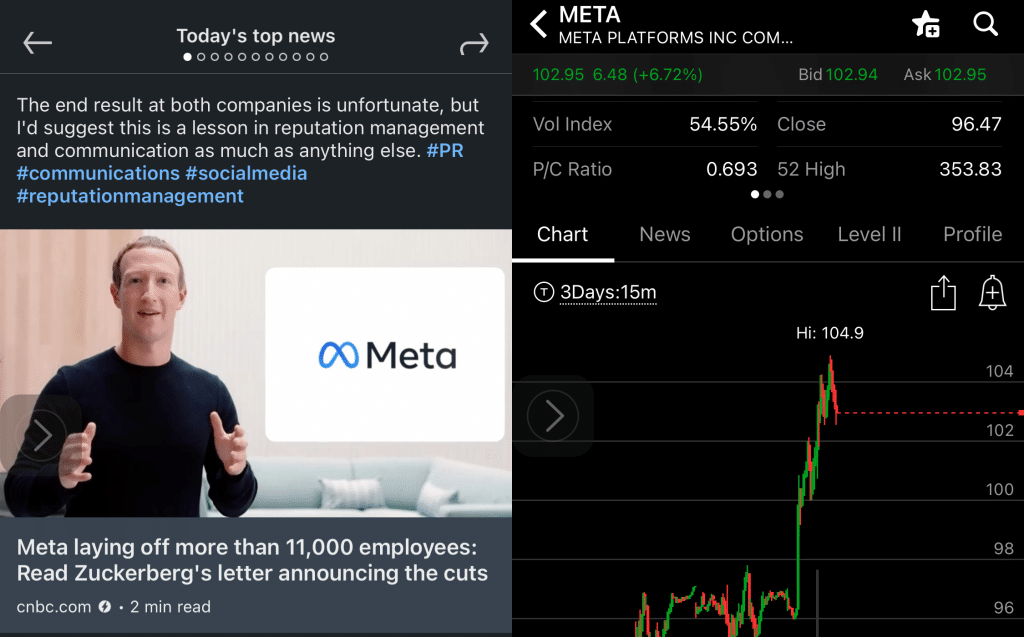
<p class="wp-block-paragraph">In the middle of the Great Resignation, perhaps it’s time for Human Resources to become Human Equity, and recognize that people aren’t completely expendable and  replaceable.</p>


<figure class="wp-block-image aligncenter size-large is-resized"><img loading="lazy" decoding="async" src="https://channelmeister.com/wp-content/uploads/2022/11/IMG_4282b-1024x637.png" alt="" class="wp-image-2832" width="580" height="360"/><figcaption class="wp-element-caption">Meta&#8217;s stock soars as Zuckerberg announces layoffs.</figcaption></figure>


<p class="wp-block-paragraph">Maybe then, the Stock Market would not get so excited when a company loses half of their best people, who will end up with the competition.</p>The post <a href="https://thrivemonger.com/business-and-innovation-tdp/what-hr-could-learn-from-the-services-folks-the-daily-ppill-214/">What HR could learn from the services folks – The Daily PPILL #214</a> appeared first on <a href="https://thrivemonger.com">The ThriveMonger</a>.]]></content:encoded>


		<post-id xmlns="com-wordpress:feed-additions:1">2801</post-id>	</item>
		<item>
		<title>Without Customer Success practices, you&#8217;re blind &#8211; The Daily PPILL #207</title>
		<link>https://thrivemonger.com/business-and-innovation-tdp/without-customer-success-practices-your-blind-the-daily-ppill-207/?utm_source=rss&#038;utm_medium=rss&#038;utm_campaign=without-customer-success-practices-your-blind-the-daily-ppill-207</link>
		
		<dc:creator><![CDATA[admin]]></dc:creator>
		<pubDate>Tue, 22 Nov 2022 13:50:00 +0000</pubDate>
				<category><![CDATA[Daily PPILL]]></category>
		<category><![CDATA[Process]]></category>
		<category><![CDATA[business processes]]></category>
		<category><![CDATA[Customer Success]]></category>
		<guid isPermaLink="false">https://channelmeister.com/?p=2799</guid>

					<description><![CDATA[<a href="https://thrivemonger.com/business-and-innovation-tdp/without-customer-success-practices-your-blind-the-daily-ppill-207/" title="Without Customer Success practices, you&#8217;re blind &#8211; The Daily PPILL #207" rel="nofollow"><img width="867" height="1300" src="https://thrivemonger.com/wp-content/uploads/2022/11/pexels-photo-11611449.jpeg" class="webfeedsFeaturedVisual wp-post-image" alt="man with eyes covered by cloth" style="display: block; margin: auto; margin-bottom: 5px;max-width: 100%;" link_thumbnail="1" decoding="async" loading="lazy" srcset="https://thrivemonger.com/wp-content/uploads/2022/11/pexels-photo-11611449.jpeg 867w, https://thrivemonger.com/wp-content/uploads/2022/11/pexels-photo-11611449-480x720.jpeg 480w" sizes="(min-width: 0px) and (max-width: 480px) 480px, (min-width: 481px) 867px, 100vw" /></a><p>It is like a veil has been lifted from our eyes.</p>
The post <a href="https://thrivemonger.com/business-and-innovation-tdp/without-customer-success-practices-your-blind-the-daily-ppill-207/">Without Customer Success practices, you’re blind – The Daily PPILL #207</a> appeared first on <a href="https://thrivemonger.com">The ThriveMonger</a>.]]></description>
										<content:encoded><![CDATA[<a href="https://thrivemonger.com/business-and-innovation-tdp/without-customer-success-practices-your-blind-the-daily-ppill-207/" title="Without Customer Success practices, you&#8217;re blind &#8211; The Daily PPILL #207" rel="nofollow"><img width="867" height="1300" src="https://thrivemonger.com/wp-content/uploads/2022/11/pexels-photo-11611449.jpeg" class="webfeedsFeaturedVisual wp-post-image" alt="man with eyes covered by cloth" style="display: block; margin: auto; margin-bottom: 5px;max-width: 100%;" link_thumbnail="1" decoding="async" loading="lazy" srcset="https://thrivemonger.com/wp-content/uploads/2022/11/pexels-photo-11611449.jpeg 867w, https://thrivemonger.com/wp-content/uploads/2022/11/pexels-photo-11611449-480x720.jpeg 480w" sizes="(min-width: 0px) and (max-width: 480px) 480px, (min-width: 481px) 867px, 100vw" /></a><p class="has-drop-cap wp-block-paragraph">Peter Drucker, in his book, &#8220;The Effective Executive&#8221; makes the point that is very hard to understand what customers are doing because there is no insight into what goes on inside their walls. Because of this, companies tend to be managed mostly in isolation, occupied by internal issues and projects; when in reality all that can affect the company happens outside. Therefore all valuable information is external.</p>


<p class="wp-block-paragraph">Luckily, the world has changed. And by adopting a partnership approach, companies can can learn about what preoccupies their customers, continually, by implementing Customer Success practices.</p>


<p class="wp-block-paragraph">We&#8217;ll never know what Drucker would have thought about this, but it is like a veil has been lifted from our eyes.</p>The post <a href="https://thrivemonger.com/business-and-innovation-tdp/without-customer-success-practices-your-blind-the-daily-ppill-207/">Without Customer Success practices, you’re blind – The Daily PPILL #207</a> appeared first on <a href="https://thrivemonger.com">The ThriveMonger</a>.]]></content:encoded>


		<post-id xmlns="com-wordpress:feed-additions:1">2799</post-id>	</item>
		<item>
		<title>Ciclo LAER: El ERROR DE CAPA 8 es ahora también nuestro problema</title>
		<link>https://thrivemonger.com/espanol/ciclo-laer-el-error-de-capa-8-es-ahora-tambien-nuestro-problema-2/?utm_source=rss&#038;utm_medium=rss&#038;utm_campaign=ciclo-laer-el-error-de-capa-8-es-ahora-tambien-nuestro-problema-2</link>
		
		<dc:creator><![CDATA[admin]]></dc:creator>
		<pubDate>Fri, 07 Oct 2022 01:38:54 +0000</pubDate>
				<category><![CDATA[Español]]></category>
		<category><![CDATA[business processes]]></category>
		<category><![CDATA[Customer Success]]></category>
		<category><![CDATA[leadership]]></category>
		<category><![CDATA[Productivity]]></category>
		<guid isPermaLink="false">https://channelmeister.com/?p=2594</guid>

					<description><![CDATA[<a href="https://thrivemonger.com/espanol/ciclo-laer-el-error-de-capa-8-es-ahora-tambien-nuestro-problema-2/" title="Ciclo LAER: El ERROR DE CAPA 8 es ahora también nuestro problema" rel="nofollow"><img width="1536" height="1025" src="https://thrivemonger.com/wp-content/uploads/2022/02/pexels-photo-3183202-1536x1025.jpeg" class="webfeedsFeaturedVisual wp-post-image" alt="person using macbook pro" style="display: block; margin: auto; margin-bottom: 5px;max-width: 100%;" link_thumbnail="1" decoding="async" loading="lazy" srcset="https://thrivemonger.com/wp-content/uploads/2022/02/pexels-photo-3183202-1536x1025.jpeg 1536w, https://thrivemonger.com/wp-content/uploads/2022/02/pexels-photo-3183202-1280x854.jpeg 1280w, https://thrivemonger.com/wp-content/uploads/2022/02/pexels-photo-3183202-980x654.jpeg 980w, https://thrivemonger.com/wp-content/uploads/2022/02/pexels-photo-3183202-480x320.jpeg 480w" sizes="(min-width: 0px) and (max-width: 480px) 480px, (min-width: 481px) and (max-width: 980px) 980px, (min-width: 981px) and (max-width: 1280px) 1280px, (min-width: 1281px) 1536px, 100vw" /></a><p>En un mundo donde cada vez más los servicios están substituyendo a los productos, es importante entender el rol que juega la atención al cliente y cómo esta puede afectar el ritmo de atrición de los usuarios. En el universo XaaS, donde cualquier cosa se ofrece en una modalidad de pago mensual, la única métrica [&#8230;]</p>
The post <a href="https://thrivemonger.com/espanol/ciclo-laer-el-error-de-capa-8-es-ahora-tambien-nuestro-problema-2/">Ciclo LAER: El ERROR DE CAPA 8 es ahora también nuestro problema</a> appeared first on <a href="https://thrivemonger.com">The ThriveMonger</a>.]]></description>
										<content:encoded><![CDATA[<a href="https://thrivemonger.com/espanol/ciclo-laer-el-error-de-capa-8-es-ahora-tambien-nuestro-problema-2/" title="Ciclo LAER: El ERROR DE CAPA 8 es ahora también nuestro problema" rel="nofollow"><img width="1536" height="1025" src="https://thrivemonger.com/wp-content/uploads/2022/02/pexels-photo-3183202-1536x1025.jpeg" class="webfeedsFeaturedVisual wp-post-image" alt="person using macbook pro" style="display: block; margin: auto; margin-bottom: 5px;max-width: 100%;" link_thumbnail="1" decoding="async" loading="lazy" srcset="https://thrivemonger.com/wp-content/uploads/2022/02/pexels-photo-3183202-1536x1025.jpeg 1536w, https://thrivemonger.com/wp-content/uploads/2022/02/pexels-photo-3183202-1280x854.jpeg 1280w, https://thrivemonger.com/wp-content/uploads/2022/02/pexels-photo-3183202-980x654.jpeg 980w, https://thrivemonger.com/wp-content/uploads/2022/02/pexels-photo-3183202-480x320.jpeg 480w" sizes="(min-width: 0px) and (max-width: 480px) 480px, (min-width: 481px) and (max-width: 980px) 980px, (min-width: 981px) and (max-width: 1280px) 1280px, (min-width: 1281px) 1536px, 100vw" /></a><p class="has-drop-cap wp-block-paragraph">En un mundo donde cada vez más los servicios están substituyendo a los productos, es importante entender el rol que juega la atención al cliente y cómo esta puede afectar el ritmo de atrición de los usuarios. En el universo XaaS, donde cualquier cosa se ofrece en una modalidad de pago mensual, la única métrica que importa en realidad para medir el desempeño de una empresa, es la tasa neta de crecimiento de una cuenta, o del agregado de todas las cuentas. Otras métricas como por ejemplo el volumen de ventas, pasan a segundo plano. </p>


<p class="wp-block-paragraph">Parafraseando lo obvio, si una empresa basada en un régimen de subscripción va adquiriendo nuevos clientes (vendiendo), pero a su vez va perdiendo clientes (atrición) con una velocidad mayor, se estará contrayendo. Los modelos tradicionales de ventas generalmente ignoran esta dinámica. </p>


<p class="wp-block-paragraph"><strong>EL RECORRIDO DEL CLIENTE EN PRODUCTOS TRADICIONALES</strong></p>


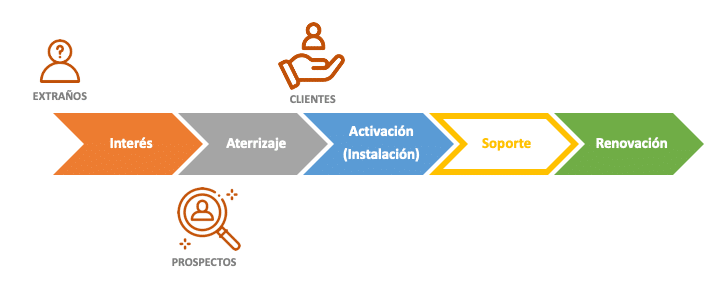
<p class="wp-block-paragraph">En un modelo tradicional del recorrido del cliente, generalmente se representa de una forma lineal. Los clientes se encuentran con las soluciones de la empresa y se hacen de su conocimiento a través de los esfuerzos de mercadotecnia de la empresa. Inmediatamente, el equipo de ventas aborda al cliente para verificar el interés y si la solución encaja dentro de las necesidades del cliente, y éste decide comprar, pues se cierra la transacción y se pasa a la fase de instalación y activación. </p>


<p class="wp-block-paragraph">Es así como los clientes pasan de ser extraños, a prospectos, y finalmente se convierten realmente en clientes de la empresa.</p>


<figure class="wp-block-image aligncenter size-full"><img loading="lazy" decoding="async" width="713" height="282" src="https://channelmeister.com/wp-content/uploads/2022/02/LAER-Enablement-Presentation.png" alt="" class="wp-image-1092" srcset="https://channelmeister.com/wp-content/uploads/2022/02/LAER-Enablement-Presentation.png 713w, https://channelmeister.com/wp-content/uploads/2022/02/LAER-Enablement-Presentation-480x190.png 480w" sizes="(min-width: 0px) and (max-width: 480px) 480px, (min-width: 481px) 713px, 100vw" /><figcaption>Modelo tradicional del recorrido del cliente</figcaption></figure>


<p class="wp-block-paragraph">Una vez que la venta se haya consumado y el producto se entrega, la empresa generalmente interactúa poco con el cliente y sólo se involucra si se manifiesta algún problema, o una vez que el cliente decida refrescar su solución. </p>


<p class="wp-block-paragraph"><strong>UN MODELO DIFERENTE PARA EL RECORRIDO DEL CLIENTE</strong></p>


<p class="wp-block-paragraph">Hay dos diferencias básicas muy importantes con el modelo anterior en el mundo de los servicios, o &#8220;as a service&#8221;.</p>


<p class="wp-block-paragraph">La primera es que el cliente es capaz de cancelar el servicio en cualquier momento. Cierto, en muchas ocasiones hay cláusulas de cancelación temprana, pero la idea es la misma. Una vez que el período cautivo acaba, el cliente puede prescindir de los servicios. Esto por lo general ocurre porque el cliente no está utilizando la solución a cabalidad y -como decimos- no está &#8220;extrayendo el valor total&#8221; de la solución. En una gran mayoría de los casos esto ocurre por una pobre adopción de la solución dentro de la organización del cliente. Es lógico que el cliente termine por cancelar el servicio si no está utilizando la solución.</p>


<p class="wp-block-paragraph">La segunda diferencia es que si el cliente atraviesa un ciclo estelar de adopción, por lo general también descubre nuevos usos para la solución, y también agrega más usuarios a la misma. </p>


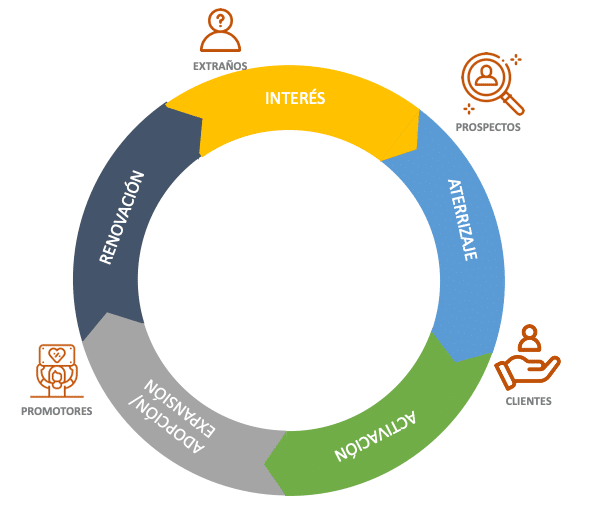
<p class="wp-block-paragraph">Estas particularidades son las que le dan origen a un nuevo paradigma del recorrido del cliente, y en particular hablamos del modelo LAER (por sus siglas en Inglés), que vendría siendo algo como:</p>


<p class="has-text-align-center wp-block-paragraph"><strong>LAND</strong>=ATERRIZAJE</p>


<p class="has-text-align-center wp-block-paragraph"><strong>ADOPT</strong>=ADOPCIÓN</p>


<p class="has-text-align-center wp-block-paragraph"><strong>EXPAND</strong>=EXPANSIÓN</p>


<p class="has-text-align-center wp-block-paragraph"><strong>RENEW</strong>=RENOVACIÓN</p>


<figure class="wp-block-image aligncenter size-full"><img loading="lazy" decoding="async" width="591" height="514" src="https://channelmeister.com/wp-content/uploads/2022/02/LAER-Enablement-Presentation2.png" alt="" class="wp-image-1093" srcset="https://channelmeister.com/wp-content/uploads/2022/02/LAER-Enablement-Presentation2.png 591w, https://channelmeister.com/wp-content/uploads/2022/02/LAER-Enablement-Presentation2-480x417.png 480w" sizes="(min-width: 0px) and (max-width: 480px) 480px, (min-width: 481px) 591px, 100vw" /><figcaption>Modelo LAER</figcaption></figure>


<p class="wp-block-paragraph">Acabamos de discutir brevemente la Adopción y la Expansión. El Aterrizaje se refiere a la venta inicial, cuando &#8220;aterrizamos&#8221; en una cuenta, y la Renovación, pues obviamente es cuando se restablece el compromiso de continuar en la relación comercial. Es importante señalar, que estos ciclos se pueden hacer tan rápidos y granulares como se desee. De hecho, técnicamente en muchas soluciones XaaS, el ciclo de renovación ocurre en períodos de un mes. </p>


<p class="wp-block-paragraph">La importancia en adoptar este modelo radica en el hecho de que TODAS las etapas pueden afectar de manera positiva o negativa el volumen de negocios de la empresa. Sólo como ejemplo, es posible aumentar los ingresos, Aterrizando mas clientes, haciendo que un cliente nuevo Adopte mejor la solución, o que uno existente Expanda el uso de la solución y Renueve.</p>


<p class="wp-block-paragraph">Este modelo lo encuentro útil no sólo para utilizarlo en el contexto de servicios de tecnología, sino también en cualquier escenario donde hay un servicio que es contratado en un modelo recurrente. Por supuesto que en estos incluyo servicios como Spotify o Netflix, donde un ejemplo de adopción adecuada podría ser el haber configurado de manera adecuada los &#8220;playlists&#8221;, a fin de que pueda escuchar o ver el contenido que me agrada; pero el modelo también se extiende a otras áreas: el pago de alquiler, el seguro de salud, la membresía del gimnasio, los pagos de condominio, e inclusive el pago de impuestos a la propiedad.</p>


<p class="wp-block-paragraph"><strong>EL VERDADERO ROL DE LA GESTIÓN ÉXITO DEL CLIENTE (CUSTOMER SUCCESS)</strong></p>


<p class="wp-block-paragraph">Una de las razones principales que me motivó a escribir este artículo, es haber visto como los términos de &#8220;Éxito del Cliente&#8221;, &#8220;Atención al Cliente&#8221;, y hasta &#8220;Soporte&#8221; se utilizan de manera intercambiable, y lamentablemente incorrecta; muchas veces por las mismas personas responsables en implementar estos procesos.</p>


<p class="wp-block-paragraph">Para el momento en que escribo esto, el término &#8220;Exito del Cliente&#8221; ni siquiera está definido en Wikipedia, pero -creo yo- una buena aproximación es que <strong>es una metodología que persigue que los clientes alcancen los resultados deseados mientras utilizan nuestra solución</strong>. ALCANCEN LOS RESULTADOS.</p>


<p class="wp-block-paragraph">Y aquí es donde se define la diferencia fundamental entre una disciplina de soporte y la del Exito del Cliente. En una forma tradicional de Satisfacción del Cliente o de Soporte Técnico, el objetivo es <strong>asegurarse que la solución esté funcionando de la forma en que se prometió</strong>. En este sentido, muchas veces era aceptable que el departamento de Servicio Técnico pronunciara -palabras más, palabras menos- un odioso: &#8220;la solución está diseñada para que funcione así, es Ud. Sra. (o Sr.) cliente quien lo está utilizando mal&#8221;. Aquí nació la frase del &#8220;Error de capa 8&#8221;, refiriéndose de forma cínica al usuario, quien está por arriba de la capa 7 (aplicativo) del modelo OSI.  </p>


<p class="wp-block-paragraph">En contraste, cuando hablamos de Exito del Cliente (y espero que vaya a quedar en evidencia cómo es más importante que nunca), no sólo debemos de asegurarnos que la solución esté funcionando como se prometió, sino que el usuario la esté utilizando como debe ser, y más aún, que la esté utilizando a todo su potencial. En este sentido y bajo el modelo LAER, se vuelve importantísimo que el cliente no solo compre la solución, sino que la implemente como debe ser, que la utilice de manera confiada, que busque utilizar todas sus funcionalidades y que finalmente la recomiende para ser usada en otras áreas de la empresa y por mas usuarios finales. </p>


<p class="wp-block-paragraph">En fin, <strong>el objetivo es que el cliente esté recibiendo el máximo valor de la solución</strong> y con ello la adopte, expanda su uso, y la renueve. </p>


<p class="wp-block-paragraph">En el mundo de todo-como-servicio, por supuesto que es importantísimo implementar otras iniciativas más asociadas al Aterrizaje (Land) -entre ellas el ajuste a los planes de compensación de ventas para hacerlo más atractivo y responsabilizar a ventas parcialmente por la retención de clientes; el aumento de la velocidad en el volante de inercia del proceso de marketing y ventas a fin de adecuarse a transacciones más pequeñas; y la automatización de procesos de provisionamiento y facturación para poderlo hacer de forma repetida y fluida- pero el rol de Soporte y de la Gestión del Éxito del Cliente es fundamental para hacerle frente al reto del resto del modelo -AER-, en la adopción, expansión y renovación; y requiere redefinir las metas y las métricas que persiguen estos departamentos. </p>


<p class="wp-block-paragraph">Todo porque ahora, la &#8220;Capa 8&#8221;, es ahora también nuestro problema.</p>The post <a href="https://thrivemonger.com/espanol/ciclo-laer-el-error-de-capa-8-es-ahora-tambien-nuestro-problema-2/">Ciclo LAER: El ERROR DE CAPA 8 es ahora también nuestro problema</a> appeared first on <a href="https://thrivemonger.com">The ThriveMonger</a>.]]></content:encoded>


		<post-id xmlns="com-wordpress:feed-additions:1">2594</post-id>	</item>
		<item>
		<title>The LAER Cycle: The Layer 8 error is now also our problem</title>
		<link>https://thrivemonger.com/the-channelmeister/the-laer-cycle-the-layer-8-error-is-now-also-our-problem/?utm_source=rss&#038;utm_medium=rss&#038;utm_campaign=the-laer-cycle-the-layer-8-error-is-now-also-our-problem</link>
		
		<dc:creator><![CDATA[admin]]></dc:creator>
		<pubDate>Fri, 08 Apr 2022 17:41:46 +0000</pubDate>
				<category><![CDATA[The Channelmeister]]></category>
		<category><![CDATA[Customer Success]]></category>
		<category><![CDATA[LAER]]></category>
		<category><![CDATA[Renewal Rate]]></category>
		<category><![CDATA[technology adoption]]></category>
		<guid isPermaLink="false">https://channelmeister.com/?p=1477</guid>

					<description><![CDATA[<a href="https://thrivemonger.com/the-channelmeister/the-laer-cycle-the-layer-8-error-is-now-also-our-problem/" title="The LAER Cycle: The Layer 8 error is now also our problem" rel="nofollow"><img width="1536" height="1025" src="https://thrivemonger.com/wp-content/uploads/2022/02/pexels-photo-3183202-1536x1025.jpeg" class="webfeedsFeaturedVisual wp-post-image" alt="person using macbook pro" style="display: block; margin: auto; margin-bottom: 5px;max-width: 100%;" link_thumbnail="1" decoding="async" loading="lazy" srcset="https://thrivemonger.com/wp-content/uploads/2022/02/pexels-photo-3183202-1536x1025.jpeg 1536w, https://thrivemonger.com/wp-content/uploads/2022/02/pexels-photo-3183202-1280x854.jpeg 1280w, https://thrivemonger.com/wp-content/uploads/2022/02/pexels-photo-3183202-980x654.jpeg 980w, https://thrivemonger.com/wp-content/uploads/2022/02/pexels-photo-3183202-480x320.jpeg 480w" sizes="(min-width: 0px) and (max-width: 480px) 480px, (min-width: 481px) and (max-width: 980px) 980px, (min-width: 981px) and (max-width: 1280px) 1280px, (min-width: 1281px) 1536px, 100vw" /></a><p>Gone are the days when Solutions Providers would install a system, make a few tests and walk away. Adoption of new solutions is crucial for unlocking the profits of the long tail in XaaS offerings.</p>
The post <a href="https://thrivemonger.com/the-channelmeister/the-laer-cycle-the-layer-8-error-is-now-also-our-problem/">The LAER Cycle: The Layer 8 error is now also our problem</a> appeared first on <a href="https://thrivemonger.com">The ThriveMonger</a>.]]></description>
										<content:encoded><![CDATA[<a href="https://thrivemonger.com/the-channelmeister/the-laer-cycle-the-layer-8-error-is-now-also-our-problem/" title="The LAER Cycle: The Layer 8 error is now also our problem" rel="nofollow"><img width="1536" height="1025" src="https://thrivemonger.com/wp-content/uploads/2022/02/pexels-photo-3183202-1536x1025.jpeg" class="webfeedsFeaturedVisual wp-post-image" alt="person using macbook pro" style="display: block; margin: auto; margin-bottom: 5px;max-width: 100%;" link_thumbnail="1" decoding="async" loading="lazy" srcset="https://thrivemonger.com/wp-content/uploads/2022/02/pexels-photo-3183202-1536x1025.jpeg 1536w, https://thrivemonger.com/wp-content/uploads/2022/02/pexels-photo-3183202-1280x854.jpeg 1280w, https://thrivemonger.com/wp-content/uploads/2022/02/pexels-photo-3183202-980x654.jpeg 980w, https://thrivemonger.com/wp-content/uploads/2022/02/pexels-photo-3183202-480x320.jpeg 480w" sizes="(min-width: 0px) and (max-width: 480px) 480px, (min-width: 481px) and (max-width: 980px) 980px, (min-width: 981px) and (max-width: 1280px) 1280px, (min-width: 1281px) 1536px, 100vw" /></a><p class="has-drop-cap wp-block-paragraph">In a world where products are increasingly being replaced by services, it is important to understand the role that customer service plays and how it can affect the rate of user attrition. In the XaaS universe, where everything is offered on a monthly payment basis, the only metric that really matters to measure the performance of a company is the net growth rate of an account, or the aggregate of all accounts. Other metrics, such as sales volume, take a backseat.</p>


<p class="wp-block-paragraph">Paraphrasing the obvious, if a company that has a subscription product is acquiring new clients (selling), but in turn, losing clients (attrition) with a greater speed, their overall revenue and client base will be contracting. Traditional sales models generally ignore this dynamic.</p>


<p class="wp-block-paragraph">There is a lot of good content out there about Customer Success, Change Management or even the LAER cycle (this last one making waves all across the industry), but the reason I decided to write this article is that I couldn&#8217;t find one single piece of content that would cover how these three things deeply interrelate.</p>


<p class="wp-block-paragraph"><strong>THE CUSTOMER JOURNEY IN TRADITIONAL PRODUCT SALES</strong></p>


<p class="wp-block-paragraph">The traditional model of the customer journey is usually represented in a linear fashion. Customers encounter the company&#8217;s solutions, becoming aware of them through the company&#8217;s marketing efforts. Immediately, the sales team approaches the client to verify interest, and if the solution fits within the client&#8217;s needs, and the client has an urgency to buy, the transaction is closed and the installation and activation phase are initiated.</p>


<p class="wp-block-paragraph">This is how customers go from being strangers to prospects, finally becoming real customers of the company.</p>


<figure class="wp-block-image aligncenter size-full"><img loading="lazy" decoding="async" width="691" height="267" src="https://channelmeister.com/wp-content/uploads/2022/03/LAER-Enablement-Presentation4.png" alt="" class="wp-image-1525" srcset="https://channelmeister.com/wp-content/uploads/2022/03/LAER-Enablement-Presentation4.png 691w, https://channelmeister.com/wp-content/uploads/2022/03/LAER-Enablement-Presentation4-480x185.png 480w" sizes="(min-width: 0px) and (max-width: 480px) 480px, (min-width: 481px) 691px, 100vw" /><figcaption class="wp-element-caption">Traditional Customer Journey model</figcaption></figure>


<p class="wp-block-paragraph">Under this traditional model, once the transaction is done and the product is delivered and installed, the company typically has little interaction with the customer and only becomes involved again if a problem arises, or once the customer decides to refresh their solution.</p>


<p class="wp-block-paragraph"><strong>THE CUSTOMER JOURNEY IN THE XaaS WORLD</strong></p>


<p class="wp-block-paragraph">There are two very important differences with the previous model in the world of services, or &#8220;as a service&#8221;.</p>


<p class="wp-block-paragraph">The first is that the customer has the option to cancel the service at any time. It is true, that on many occasions there are early cancellation clauses, but the option still exists. Once the captive period ends, the client can forego continuing with the services. Most often than not, this happens because the client is not fully using the solution and, as we say, is not &#8220;extracting the full value&#8221; of the solution. In the vast majority of cases, this is due to poor adoption of the solution within the client&#8217;s organization. The solution was purchased and installed, but nobody uses it anymore. It makes total sense that the client would end up canceling the service if they are not utilizing it.</p>


<p class="wp-block-paragraph">The second difference is that when the customer goes through a stellar cycle of adoption, they usually discover new uses for the solution, and many times, add more users to it.</p>


<p class="wp-block-paragraph">These particularities are what gave rise to a new paradigm of the customer journey, and in particular, I am referring to the LAER model. The acronym stands for LAND, ADOPT, EXPAND, and RENEW. For the sake of completeness and to be able to compare it with the previous graphic, I added here the initial encounter with the product, and the installation or activation phases as well. </p>


<p class="wp-block-paragraph"></p>


<figure class="wp-block-image aligncenter size-full"><img loading="lazy" decoding="async" width="563" height="540" src="https://channelmeister.com/wp-content/uploads/2022/04/LAER-Enablement-Presentation3.png" alt="" class="wp-image-1526" srcset="https://channelmeister.com/wp-content/uploads/2022/04/LAER-Enablement-Presentation3.png 563w, https://channelmeister.com/wp-content/uploads/2022/04/LAER-Enablement-Presentation3-480x460.png 480w" sizes="(min-width: 0px) and (max-width: 480px) 480px, (min-width: 481px) 563px, 100vw" /><figcaption class="wp-element-caption">Expanded LAER model </figcaption></figure>


<p class="wp-block-paragraph">We just briefly discussed Adoption and Expansion. Land refers to the initial sale, when we &#8220;land&#8221; at an account. Obviously, the Renewal is when the commitment to continue in the commercial relationship is reestablished. It is important to note, that these loops can be made as fast and granular as desired. In fact, technically in many XaaS solutions, the renewal cycle occurs in periods of one month, or even continually, when the customer is at &#8220;one click to cancel&#8221;.</p>


<p class="wp-block-paragraph">The importance of adopting this model lies in the fact that ALL stages can positively or negatively affect the company&#8217;s turnover. Just as an example, it is possible to increase revenue by Landing more customers, making a new customer better Adopt the solution, or an existing one Expand the use of the solution and Renew. </p>


<p class="wp-block-paragraph">I find this model useful not only in the context of technology services, but also in any scenario where there is a service that is contracted in a recurring model. Of course, in these I include services such as Spotify or Netflix, where an example of proper adoption could be having properly configured the &#8220;playlists&#8221;, so that you can listen to or watch the content that you really like; But the model extends to other areas as well: paying rent, health insurance, gym memberships, condo payments, and even paying property taxes.</p>


<p class="wp-block-paragraph"><strong>THE TRUE ROLE OF CUSTOMER SUCCESS MANAGEMENT</strong></p>


<p class="wp-block-paragraph">One of the main reasons that motivated me to write this article is to have seen how the terms &#8220;Customer Success&#8221;, &#8220;Customer Service&#8221;, and even &#8220;Support&#8221; are used interchangeably, and unfortunately incorrectly; many times by the same people responsible for implementing these processes.</p>


<p class="wp-block-paragraph">A good approximation to the definition of Customer Success is that it is a methodology that aims for customers to achieve the desired results while using our solution. </p>


<p class="wp-block-paragraph">Ultimately, the goal is for the customer to receive the maximum value from the solution and thereby adopt it, expand its use, and renew it.</p>


<p class="wp-block-paragraph">And this is where the fundamental difference between a support discipline and Customer Success is defined. In a traditional form of Customer Satisfaction or Technical Support, the goal is to make sure that the solution is working as promised. In this sense, it was often acceptable for the Technical Service department to pronounce -words more, words less- an odious: &#8220;the solution is designed to work like this, it is you, Mrs. (or Mr.) customer who is using it wrong&#8221;. This is where the phrase &#8220;Layer 8 issue&#8221; was born, cynically referring to the user, who is above layer 7 (application) of the OSI model.<br>In contrast, when we shift to Customer Success (and I hope it will become clear how important it is, now than ever), we must not only make sure that the solution is working as promised, but emphasis must shift to make sure that the user is utilizing it appropriately, and even more, using it to its full potential. In this sense and under the LAER model, it becomes very important that the client not only buys the solution but also implements it as it should, uses it confidently, seeks to use all its functionalities, and finally recommends it to be used in other areas of the company and by more end users.</p>


<figure class="wp-block-pullquote"><blockquote><p>For the traditional model of Customer Satisfaction or Technical Support, the goal is to make sure that the solution is working as promised. When we shift to Customer Success in the XaaS world, the emphasis should be that the user leverages its full potential</p></blockquote></figure>


<p class="wp-block-paragraph">In the world of everything-as-a-service, it is of course extremely important to implement initiatives generally associated with Landing -among them adjusting sales compensation plans to make it more attractive and making sales partially responsible for retaining customers; increasing the speed of the flywheel of the marketing and sales process to accommodate smaller transactions; and automate the provisioning and billing processes to be able to do it repeatedly and fluidly- but the role of Support and Customer Success Management is essential to face the challenge and unlock the profits of the long tail of the model -the AER piece- in the adoption, expansion, and renewal; requiring to redefine the goals and metrics pursued by each of these departments. </p>


<figure class="wp-block-pullquote"><blockquote><p><em>as-a-service further aligns the customer and the vendor&#8217;s goals &#8211; true &#8220;Customer Success&#8221; is the only way for the vendor&#8217;s own success</em></p></blockquote></figure>


<p class="wp-block-paragraph">As-a-service models have lovers and haters. As humans, we still like the idea of owning something. It gives us the feeling that come hell or high water, we could still count on what we have, ignoring the fact that technology solutions eventually become obsolete as they get caught in the relentless cycle of innovation. On the flip side, as-a-service focuses on the benefits, and it further aligns the customer and the vendor&#8217;s goals, so true &#8220;Customer Success&#8221; is the only way for the vendor&#8217;s own success.</p>


<p class="wp-block-paragraph">All because now, a &#8220;Layer 8 issue&#8221;, is now also our problem.</p>The post <a href="https://thrivemonger.com/the-channelmeister/the-laer-cycle-the-layer-8-error-is-now-also-our-problem/">The LAER Cycle: The Layer 8 error is now also our problem</a> appeared first on <a href="https://thrivemonger.com">The ThriveMonger</a>.]]></content:encoded>


		<post-id xmlns="com-wordpress:feed-additions:1">1477</post-id>	</item>
		<item>
		<title>Ciclo LAER: El ERROR DE CAPA 8 es ahora también nuestro problema</title>
		<link>https://thrivemonger.com/business-and-innovation-tdp/ciclo-laer-el-error-de-capa-8-es-ahora-tambien-nuestro-problema/?utm_source=rss&#038;utm_medium=rss&#038;utm_campaign=ciclo-laer-el-error-de-capa-8-es-ahora-tambien-nuestro-problema</link>
		
		<dc:creator><![CDATA[admin]]></dc:creator>
		<pubDate>Sat, 12 Feb 2022 14:35:00 +0000</pubDate>
				<category><![CDATA[Daily PPILL]]></category>
		<category><![CDATA[Español]]></category>
		<category><![CDATA[business processes]]></category>
		<category><![CDATA[Customer Success]]></category>
		<category><![CDATA[leadership]]></category>
		<category><![CDATA[Productivity]]></category>
		<guid isPermaLink="false">https://channelmeister.com/?p=1065</guid>

					<description><![CDATA[<a href="https://thrivemonger.com/business-and-innovation-tdp/ciclo-laer-el-error-de-capa-8-es-ahora-tambien-nuestro-problema/" title="Ciclo LAER: El ERROR DE CAPA 8 es ahora también nuestro problema" rel="nofollow"><img width="1536" height="1025" src="https://thrivemonger.com/wp-content/uploads/2022/02/pexels-photo-3183202-1536x1025.jpeg" class="webfeedsFeaturedVisual wp-post-image" alt="person using macbook pro" style="display: block; margin: auto; margin-bottom: 5px;max-width: 100%;" link_thumbnail="1" decoding="async" loading="lazy" srcset="https://thrivemonger.com/wp-content/uploads/2022/02/pexels-photo-3183202-1536x1025.jpeg 1536w, https://thrivemonger.com/wp-content/uploads/2022/02/pexels-photo-3183202-1280x854.jpeg 1280w, https://thrivemonger.com/wp-content/uploads/2022/02/pexels-photo-3183202-980x654.jpeg 980w, https://thrivemonger.com/wp-content/uploads/2022/02/pexels-photo-3183202-480x320.jpeg 480w" sizes="(min-width: 0px) and (max-width: 480px) 480px, (min-width: 481px) and (max-width: 980px) 980px, (min-width: 981px) and (max-width: 1280px) 1280px, (min-width: 1281px) 1536px, 100vw" /></a><p>En un mundo donde cada vez más los servicios están substituyendo a los productos, es importante entender el rol que juega la atención al cliente y cómo esta puede afectar el ritmo de atrición de los usuarios. En el universo XaaS, donde cualquier cosa se ofrece en una modalidad de pago mensual, la única métrica [&#8230;]</p>
The post <a href="https://thrivemonger.com/business-and-innovation-tdp/ciclo-laer-el-error-de-capa-8-es-ahora-tambien-nuestro-problema/">Ciclo LAER: El ERROR DE CAPA 8 es ahora también nuestro problema</a> appeared first on <a href="https://thrivemonger.com">The ThriveMonger</a>.]]></description>
										<content:encoded><![CDATA[<a href="https://thrivemonger.com/business-and-innovation-tdp/ciclo-laer-el-error-de-capa-8-es-ahora-tambien-nuestro-problema/" title="Ciclo LAER: El ERROR DE CAPA 8 es ahora también nuestro problema" rel="nofollow"><img width="1536" height="1025" src="https://thrivemonger.com/wp-content/uploads/2022/02/pexels-photo-3183202-1536x1025.jpeg" class="webfeedsFeaturedVisual wp-post-image" alt="person using macbook pro" style="display: block; margin: auto; margin-bottom: 5px;max-width: 100%;" link_thumbnail="1" decoding="async" loading="lazy" srcset="https://thrivemonger.com/wp-content/uploads/2022/02/pexels-photo-3183202-1536x1025.jpeg 1536w, https://thrivemonger.com/wp-content/uploads/2022/02/pexels-photo-3183202-1280x854.jpeg 1280w, https://thrivemonger.com/wp-content/uploads/2022/02/pexels-photo-3183202-980x654.jpeg 980w, https://thrivemonger.com/wp-content/uploads/2022/02/pexels-photo-3183202-480x320.jpeg 480w" sizes="(min-width: 0px) and (max-width: 480px) 480px, (min-width: 481px) and (max-width: 980px) 980px, (min-width: 981px) and (max-width: 1280px) 1280px, (min-width: 1281px) 1536px, 100vw" /></a><p class="has-drop-cap wp-block-paragraph">En un mundo donde cada vez más los servicios están substituyendo a los productos, es importante entender el rol que juega la atención al cliente y cómo esta puede afectar el ritmo de atrición de los usuarios. En el universo XaaS, donde cualquier cosa se ofrece en una modalidad de pago mensual, la única métrica que importa en realidad para medir el desempeño de una empresa, es la tasa neta de crecimiento de una cuenta, o del agregado de todas las cuentas. Otras métricas como por ejemplo el volumen de ventas, pasan a segundo plano. </p>


<p class="wp-block-paragraph">Parafraseando lo obvio, si una empresa basada en un régimen de subscripción va adquiriendo nuevos clientes (vendiendo), pero a su vez va perdiendo clientes (atrición) con una velocidad mayor, se estará contrayendo. Los modelos tradicionales de ventas generalmente ignoran esta dinámica. </p>


<p class="wp-block-paragraph"><strong>EL RECORRIDO DEL CLIENTE EN PRODUCTOS TRADICIONALES</strong></p>


<p class="wp-block-paragraph">En un modelo tradicional del recorrido del cliente, generalmente se representa de una forma lineal. Los clientes se encuentran con las soluciones de la empresa y se hacen de su conocimiento a través de los esfuerzos de mercadotecnia de la empresa. Inmediatamente, el equipo de ventas aborda al cliente para verificar el interés y si la solución encaja dentro de las necesidades del cliente, y éste decide comprar, pues se cierra la transacción y se pasa a la fase de instalación y activación. </p>


<p class="wp-block-paragraph">Es así como los clientes pasan de ser extraños, a prospectos, y finalmente se convierten realmente en clientes de la empresa.</p>


<figure class="wp-block-image aligncenter size-full"><img loading="lazy" decoding="async" width="713" height="282" src="https://channelmeister.com/wp-content/uploads/2022/02/LAER-Enablement-Presentation.png" alt="" class="wp-image-1092" srcset="https://channelmeister.com/wp-content/uploads/2022/02/LAER-Enablement-Presentation.png 713w, https://channelmeister.com/wp-content/uploads/2022/02/LAER-Enablement-Presentation-480x190.png 480w" sizes="(min-width: 0px) and (max-width: 480px) 480px, (min-width: 481px) 713px, 100vw" /><figcaption>Modelo tradicional del recorrido del cliente</figcaption></figure>


<p class="wp-block-paragraph">Una vez que la venta se haya consumado y el producto se entrega, la empresa generalmente interactúa poco con el cliente y sólo se involucra si se manifiesta algún problema, o una vez que el cliente decida refrescar su solución. </p>


<p class="wp-block-paragraph"><strong>UN MODELO DIFERENTE PARA EL RECORRIDO DEL CLIENTE</strong></p>


<p class="wp-block-paragraph">Hay dos diferencias básicas muy importantes con el modelo anterior en el mundo de los servicios, o &#8220;as a service&#8221;.</p>


<p class="wp-block-paragraph">La primera es que el cliente es capaz de cancelar el servicio en cualquier momento. Cierto, en muchas ocasiones hay cláusulas de cancelación temprana, pero la idea es la misma. Una vez que el período cautivo acaba, el cliente puede prescindir de los servicios. Esto por lo general ocurre porque el cliente no está utilizando la solución a cabalidad y -como decimos- no está &#8220;extrayendo el valor total&#8221; de la solución. En una gran mayoría de los casos esto ocurre por una pobre adopción de la solución dentro de la organización del cliente. Es lógico que el cliente termine por cancelar el servicio si no está utilizando la solución.</p>


<p class="wp-block-paragraph">La segunda diferencia es que si el cliente atraviesa un ciclo estelar de adopción, por lo general también descubre nuevos usos para la solución, y también agrega más usuarios a la misma. </p>


<p class="wp-block-paragraph">Estas particularidades son las que le dan origen a un nuevo paradigma del recorrido del cliente, y en particular hablamos del modelo LAER (por sus siglas en Inglés), que vendría siendo algo como:</p>


<p class="has-text-align-center wp-block-paragraph"><strong>LAND</strong>=ATERRIZAJE</p>


<p class="has-text-align-center wp-block-paragraph"><strong>ADOPT</strong>=ADOPCIÓN</p>


<p class="has-text-align-center wp-block-paragraph"><strong>EXPAND</strong>=EXPANSIÓN</p>


<p class="has-text-align-center wp-block-paragraph"><strong>RENEW</strong>=RENOVACIÓN</p>


<figure class="wp-block-image aligncenter size-full"><img loading="lazy" decoding="async" width="591" height="514" src="https://channelmeister.com/wp-content/uploads/2022/02/LAER-Enablement-Presentation2.png" alt="" class="wp-image-1093" srcset="https://channelmeister.com/wp-content/uploads/2022/02/LAER-Enablement-Presentation2.png 591w, https://channelmeister.com/wp-content/uploads/2022/02/LAER-Enablement-Presentation2-480x417.png 480w" sizes="(min-width: 0px) and (max-width: 480px) 480px, (min-width: 481px) 591px, 100vw" /><figcaption>Modelo LAER</figcaption></figure>


<p class="wp-block-paragraph">Acabamos de discutir brevemente la Adopción y la Expansión. El Aterrizaje se refiere a la venta inicial, cuando &#8220;aterrizamos&#8221; en una cuenta, y la Renovación, pues obviamente es cuando se restablece el compromiso de continuar en la relación comercial. Es importante señalar, que estos ciclos se pueden hacer tan rápidos y granulares como se desee. De hecho, técnicamente en muchas soluciones XaaS, el ciclo de renovación ocurre en períodos de un mes. </p>


<p class="wp-block-paragraph">La importancia en adoptar este modelo radica en el hecho de que TODAS las etapas pueden afectar de manera positiva o negativa el volumen de negocios de la empresa. Sólo como ejemplo, es posible aumentar los ingresos, Aterrizando mas clientes, haciendo que un cliente nuevo Adopte mejor la solución, o que uno existente Expanda el uso de la solución y Renueve.</p>


<p class="wp-block-paragraph">Este modelo lo encuentro útil no sólo para utilizarlo en el contexto de servicios de tecnología, sino también en cualquier escenario donde hay un servicio que es contratado en un modelo recurrente. Por supuesto que en estos incluyo servicios como Spotify o Netflix, donde un ejemplo de adopción adecuada podría ser el haber configurado de manera adecuada los &#8220;playlists&#8221;, a fin de que pueda escuchar o ver el contenido que me agrada; pero el modelo también se extiende a otras áreas: el pago de alquiler, el seguro de salud, la membresía del gimnasio, los pagos de condominio, e inclusive el pago de impuestos a la propiedad.</p>


<p class="wp-block-paragraph"><strong>EL VERDADERO ROL DE LA GESTIÓN ÉXITO DEL CLIENTE (CUSTOMER SUCCESS)</strong></p>


<p class="wp-block-paragraph">Una de las razones principales que me motivó a escribir este artículo, es haber visto como los términos de &#8220;Éxito del Cliente&#8221;, &#8220;Atención al Cliente&#8221;, y hasta &#8220;Soporte&#8221; se utilizan de manera intercambiable, y lamentablemente incorrecta; muchas veces por las mismas personas responsables en implementar estos procesos.</p>


<p class="wp-block-paragraph">Para el momento en que escribo esto, el término &#8220;Exito del Cliente&#8221; ni siquiera está definido en Wikipedia, pero -creo yo- una buena aproximación es que <strong>es una metodología que persigue que los clientes alcancen los resultados deseados mientras utilizan nuestra solución</strong>. ALCANCEN LOS RESULTADOS.</p>


<p class="wp-block-paragraph">Y aquí es donde se define la diferencia fundamental entre una disciplina de soporte y la del Exito del Cliente. En una forma tradicional de Satisfacción del Cliente o de Soporte Técnico, el objetivo es <strong>asegurarse que la solución esté funcionando de la forma en que se prometió</strong>. En este sentido, muchas veces era aceptable que el departamento de Servicio Técnico pronunciara -palabras más, palabras menos- un odioso: &#8220;la solución está diseñada para que funcione así, es Ud. Sra. (o Sr.) cliente quien lo está utilizando mal&#8221;. Aquí nació la frase del &#8220;Error de capa 8&#8221;, refiriéndose de forma cínica al usuario, quien está por arriba de la capa 7 (aplicativo) del modelo OSI.  </p>


<p class="wp-block-paragraph">En contraste, cuando hablamos de Exito del Cliente (y espero que vaya a quedar en evidencia cómo es más importante que nunca), no sólo debemos de asegurarnos que la solución esté funcionando como se prometió, sino que el usuario la esté utilizando como debe ser, y más aún, que la esté utilizando a todo su potencial. En este sentido y bajo el modelo LAER, se vuelve importantísimo que el cliente no solo compre la solución, sino que la implemente como debe ser, que la utilice de manera confiada, que busque utilizar todas sus funcionalidades y que finalmente la recomiende para ser usada en otras áreas de la empresa y por mas usuarios finales. </p>


<p class="wp-block-paragraph">En fin, <strong>el objetivo es que el cliente esté recibiendo el máximo valor de la solución</strong> y con ello la adopte, expanda su uso, y la renueve. </p>


<p class="wp-block-paragraph">En el mundo de todo-como-servicio, por supuesto que es importantísimo implementar otras iniciativas más asociadas al Aterrizaje (Land) -entre ellas el ajuste a los planes de compensación de ventas para hacerlo más atractivo y responsabilizar a ventas parcialmente por la retención de clientes; el aumento de la velocidad en el volante de inercia del proceso de marketing y ventas a fin de adecuarse a transacciones más pequeñas; y la automatización de procesos de provisionamiento y facturación para poderlo hacer de forma repetida y fluida- pero el rol de Soporte y de la Gestión del Éxito del Cliente es fundamental para hacerle frente al reto del resto del modelo -AER-, en la adopción, expansión y renovación; y requiere redefinir las metas y las métricas que persiguen estos departamentos. </p>


<p class="wp-block-paragraph">Todo porque ahora, la &#8220;Capa 8&#8221;, es ahora también nuestro problema.</p>The post <a href="https://thrivemonger.com/business-and-innovation-tdp/ciclo-laer-el-error-de-capa-8-es-ahora-tambien-nuestro-problema/">Ciclo LAER: El ERROR DE CAPA 8 es ahora también nuestro problema</a> appeared first on <a href="https://thrivemonger.com">The ThriveMonger</a>.]]></content:encoded>


		<post-id xmlns="com-wordpress:feed-additions:1">1065</post-id>	</item>
	</channel>
</rss>