
In a world where products are increasingly being replaced by services, it is important to understand the role that customer service plays and how it can affect the rate of user attrition. In the XaaS universe, where everything is offered on a monthly payment basis, the only metric that really matters to measure the performance of a company is the net growth rate of an account, or the aggregate of all accounts. Other metrics, such as sales volume, take a backseat.
Paraphrasing the obvious, if a company that has a subscription product is acquiring new clients (selling), but in turn, losing clients (attrition) with a greater speed, their overall revenue and client base will be contracting. Traditional sales models generally ignore this dynamic.
There is a lot of good content out there about Customer Success, Change Management or even the LAER cycle (this last one making waves all across the industry), but the reason I decided to write this article is that I couldn't find one single piece of content that would cover how these three things deeply interrelate.
THE CUSTOMER JOURNEY IN TRADITIONAL PRODUCT SALES
The traditional model of the customer journey is usually represented in a linear fashion. Customers encounter the company's solutions, becoming aware of them through the company's marketing efforts. Immediately, the sales team approaches the client to verify interest, and if the solution fits within the client's needs, and the client has an urgency to buy, the transaction is closed and the installation and activation phase are initiated.
This is how customers go from being strangers to prospects, finally becoming real customers of the company.
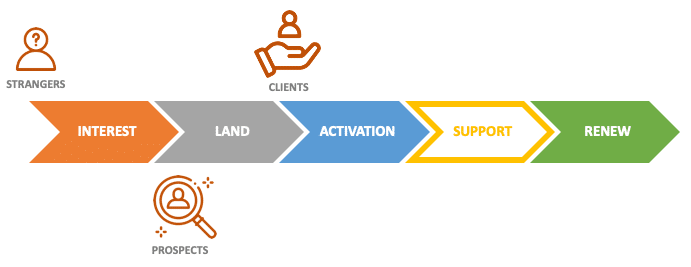
Under this traditional model, once the transaction is done and the product is delivered and installed, the company typically has little interaction with the customer and only becomes involved again if a problem arises, or once the customer decides to refresh their solution.
THE CUSTOMER JOURNEY IN THE XaaS WORLD
There are two very important differences with the previous model in the world of services, or "as a service".
The first is that the customer has the option to cancel the service at any time. It is true, that on many occasions there are early cancellation clauses, but the option still exists. Once the captive period ends, the client can forego continuing with the services. Most often than not, this happens because the client is not fully using the solution and, as we say, is not "extracting the full value" of the solution. In the vast majority of cases, this is due to poor adoption of the solution within the client's organization. The solution was purchased and installed, but nobody uses it anymore. It makes total sense that the client would end up canceling the service if they are not utilizing it.
The second difference is that when the customer goes through a stellar cycle of adoption, they usually discover new uses for the solution, and many times, add more users to it.
These particularities are what gave rise to a new paradigm of the customer journey, and in particular, I am referring to the LAER model. The acronym stands for LAND, ADOPT, EXPAND, and RENEW. For the sake of completeness and to be able to compare it with the previous graphic, I added here the initial encounter with the product, and the installation or activation phases as well.
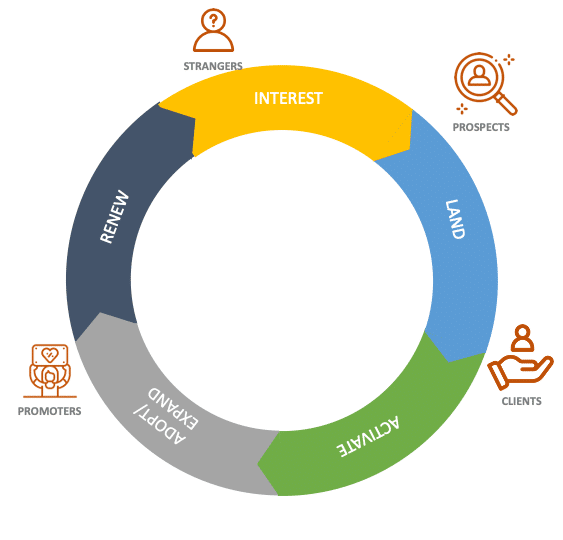
We just briefly discussed Adoption and Expansion. Land refers to the initial sale, when we "land" at an account. Obviously, the Renewal is when the commitment to continue in the commercial relationship is reestablished. It is important to note, that these loops can be made as fast and granular as desired. In fact, technically in many XaaS solutions, the renewal cycle occurs in periods of one month, or even continually, when the customer is at "one click to cancel".
The importance of adopting this model lies in the fact that ALL stages can positively or negatively affect the company's turnover. Just as an example, it is possible to increase revenue by Landing more customers, making a new customer better Adopt the solution, or an existing one Expand the use of the solution and Renew.
I find this model useful not only in the context of technology services, but also in any scenario where there is a service that is contracted in a recurring model. Of course, in these I include services such as Spotify or Netflix, where an example of proper adoption could be having properly configured the "playlists", so that you can listen to or watch the content that you really like; But the model extends to other areas as well: paying rent, health insurance, gym memberships, condo payments, and even paying property taxes.
THE TRUE ROLE OF CUSTOMER SUCCESS MANAGEMENT
One of the main reasons that motivated me to write this article is to have seen how the terms "Customer Success", "Customer Service", and even "Support" are used interchangeably, and unfortunately incorrectly; many times by the same people responsible for implementing these processes.
A good approximation to the definition of Customer Success is that it is a methodology that aims for customers to achieve the desired results while using our solution.
Ultimately, the goal is for the customer to receive the maximum value from the solution and thereby adopt it, expand its use, and renew it.
And this is where the fundamental difference between a support discipline and Customer Success is defined. In a traditional form of Customer Satisfaction or Technical Support, the goal is to make sure that the solution is working as promised. In this sense, it was often acceptable for the Technical Service department to pronounce -words more, words less- an odious: "the solution is designed to work like this, it is you, Mrs. (or Mr.) customer who is using it wrong". This is where the phrase "Layer 8 issue" was born, cynically referring to the user, who is above layer 7 (application) of the OSI model.
In contrast, when we shift to Customer Success (and I hope it will become clear how important it is, now than ever), we must not only make sure that the solution is working as promised, but emphasis must shift to make sure that the user is utilizing it appropriately, and even more, using it to its full potential. In this sense and under the LAER model, it becomes very important that the client not only buys the solution but also implements it as it should, uses it confidently, seeks to use all its functionalities, and finally recommends it to be used in other areas of the company and by more end users.
For the traditional model of Customer Satisfaction or Technical Support, the goal is to make sure that the solution is working as promised. When we shift to Customer Success in the XaaS world, the emphasis should be that the user leverages its full potential
In the world of everything-as-a-service, it is of course extremely important to implement initiatives generally associated with Landing -among them adjusting sales compensation plans to make it more attractive and making sales partially responsible for retaining customers; increasing the speed of the flywheel of the marketing and sales process to accommodate smaller transactions; and automate the provisioning and billing processes to be able to do it repeatedly and fluidly- but the role of Support and Customer Success Management is essential to face the challenge and unlock the profits of the long tail of the model -the AER piece- in the adoption, expansion, and renewal; requiring to redefine the goals and metrics pursued by each of these departments.
as-a-service further aligns the customer and the vendor's goals - true "Customer Success" is the only way for the vendor's own success
As-a-service models have lovers and haters. As humans, we still like the idea of owning something. It gives us the feeling that come hell or high water, we could still count on what we have, ignoring the fact that technology solutions eventually become obsolete as they get caught in the relentless cycle of innovation. On the flip side, as-a-service focuses on the benefits, and it further aligns the customer and the vendor's goals, so true "Customer Success" is the only way for the vendor's own success.
For more on how XaaS businesses can build a solid foundation based on Customer Success practices, download our free booklet "Customer Success: The imperative for XaaS businesses".